Can You Put Hot Liquid in a Blender? What Manuals Say
It depends on the blender. Vitamix and nutribullet pitchers allow hot liquid with a vented lid; Ninja's BL660 guide and sealed cups say never.
Can you put hot liquid in a blender? It depends on the blender. Vitamix’s 5200 manual and nutribullet’s Combo pitcher guide allow hot liquids if the lid is locked and vented, the container is below max, and you start on the lowest speed. Ninja’s BL660 Professional owner’s guide says do not blend hot liquids. And never blend hot liquid in a sealed personal cup; nutribullet’s guide bans it outright.
Why hot liquid in a blender is risky: steam, pressure and a sealed lid
When a blender lid blows off hot soup, steam pressure is the cause most sources give. The Daily Meal, citing Food Network, says hot liquids expand as they blend and steam pressure can push the lid off. nutribullet’s NBF50500 user guide says heated ingredients can pressurize a sealed container and “violently expel hot contents.”
Vitamix’s 5200 owner’s manual warns that “spray or escaping steam may cause scalding and burns.” It says to lock the lid so that expansion does not shift it.
Heat can also come from the blender itself. In TechGearLab’s tomato soup test, the Vitamix 5200 brought the soup to 152.4°F and the nutribullet Combo to 145°F; TechGearLab credits friction from extended high-speed blending. It recorded 74°F for the Ninja BN701 in the same comparison, so not every blender does this. nutribullet’s guide says friction from prolonged blending can heat ingredients and build pressure, which is why it tells you to stop if a vessel feels warm.
What each manufacturer says about hot liquids
The manuals disagree, so the safe answer depends on your blender. Every cell below comes from the manufacturer’s manual or FAQ linked in the last column.
| Blender / container | Hot liquids allowed? | Fill limit | Starting speed | Lid / cap rule | Source (manual or FAQ, linked) |
|---|---|---|---|---|---|
| Vitamix 5200 container | Yes, “use caution” | “Do not fill container to the maximum capacity” | Variable speed 1, then slowly up to 10 | Lid and lid plug firmly in place; lock the lid | Vitamix 5200 manual |
| nutribullet Combo pitcher | Yes, with vented lid cap | Below the MAX lines | LOW | Pitcher lid and vented lid cap locked | nutribullet NBF50500 guide |
| nutribullet sealed cups | Never; start at 70°F or cooler | Not published for heat | Not published for heat | Sealed; never blend hot ingredients | nutribullet NBF50500 guide |
| Ninja Professional (BL660 guide) | No; “not intended for hot blending” | Not published for heat | Not published for heat | Cool soups to room temperature first | Ninja BL660 owner’s guide |
| Philips (HR3868/90, HR1647/00, HR1670/90) | Not “very hot”; cool below 60°C/140°F to avoid jar damage | Not published | Not published | Not published | Philips FAQ |
| KitchenAid | Yes, cool first “if possible” | Not published | Low or Pulse, then increase | Vented measuring cap stays in place | KitchenAid UK FAQ |
The Ninja row comes from the BL660 guide only. I have not read the BN701, BL610 or DB351 guides, so check your own model’s manual before assuming the same rule applies.
Can you blend hot liquid in a nutribullet?
In the cups, no. In the Combo pitcher, yes, with conditions. nutribullet’s NBF50500 guide says to “never blend hot ingredients or liquid in any sealed nutribullet cup,” because the pressure can cause cup and blade separation. It says cup ingredients should start at 70°F or cooler, and blending should generally last less than a minute.
If a cup feels warm, the guide says to power off and let it cool for 15 minutes or more before opening it. The pitcher is different: hot liquids are allowed only with the pitcher lid and vented lid cap locked, ingredients below MAX, and blending started on LOW.
In 2017, TODAY reported a lawsuit in which at least 22 people alleged that NutriBullet blenders exploded; their attorney said some were severely burned. These are allegations. NutriBullet called the reports “perplexing” and its attorney told Fox News the likely culprit was misuse.
Can you put hot liquid in a Ninja blender?
Not according to Ninja. The BL660 Professional owner’s guide says: “Do not blend hot liquids, doing so may cause excessive pressure build-up, resulting in risk of the user being burned.” It adds that sauces and soups should be cooled to room temperature first.
Some generic articles, including Tasting Table, suggest a towel over the lid or “burping” the lid instead. That advice contradicts this manual. On a Ninja BL660, follow the manual and cool the soup first. If you own the Ninja DB351, a personal blender with a 26 oz tumbler, check its own manual; I have not opened it.
How to blend hot soup safely when your manual allows it
Blending hot soup safely starts with your own manual. If it allows hot liquids, these steps follow the Vitamix, nutribullet, KitchenAid and Philips instructions linked above:
- Check the manual first. If it says no hot liquids, as Ninja’s BL660 guide does, stop here and cool the soup.
- Let the soup cool. Philips says below 60°C, or 140°F, to avoid damaging its jars. KitchenAid says to cool hot foods “if possible.”
- Stay below the max line. Vitamix says not to fill to maximum capacity; nutribullet says keep ingredients below MAX.
- Lock the lid with the vented cap or lid plug in place. Vitamix and nutribullet both require it, and nutribullet says the cap “allows steam and pressure to escape.”
- Start on the lowest speed, then increase slowly. Vitamix says variable speed 1; nutribullet says LOW; KitchenAid says Low or Pulse.
- Keep hands and other exposed skin away from the lid opening. Vitamix and nutribullet both say this.
- Wait for the blades to stop before opening. Vitamix says so. nutribullet says to let a warm vessel cool completely, then open it pointed away from your body.
Keep the vented cap or lid plug in while blending. nutribullet says never blend hot liquids without the vented lid cap locked; Vitamix says to remove the lid plug only to add ingredients or use the tamper. The Daily Meal suggests removing the lid section and holding a towel over the opening, which conflicts with both manuals.
Safer alternatives: cool first, use an immersion blender, or blend cold then heat
The simplest option is to blend cold and heat afterward. nutribullet’s guide says to blend at 70°F or less, then heat on the stovetop, and to check the temperature with a thermometer. It also says not to put the container on the stovetop.
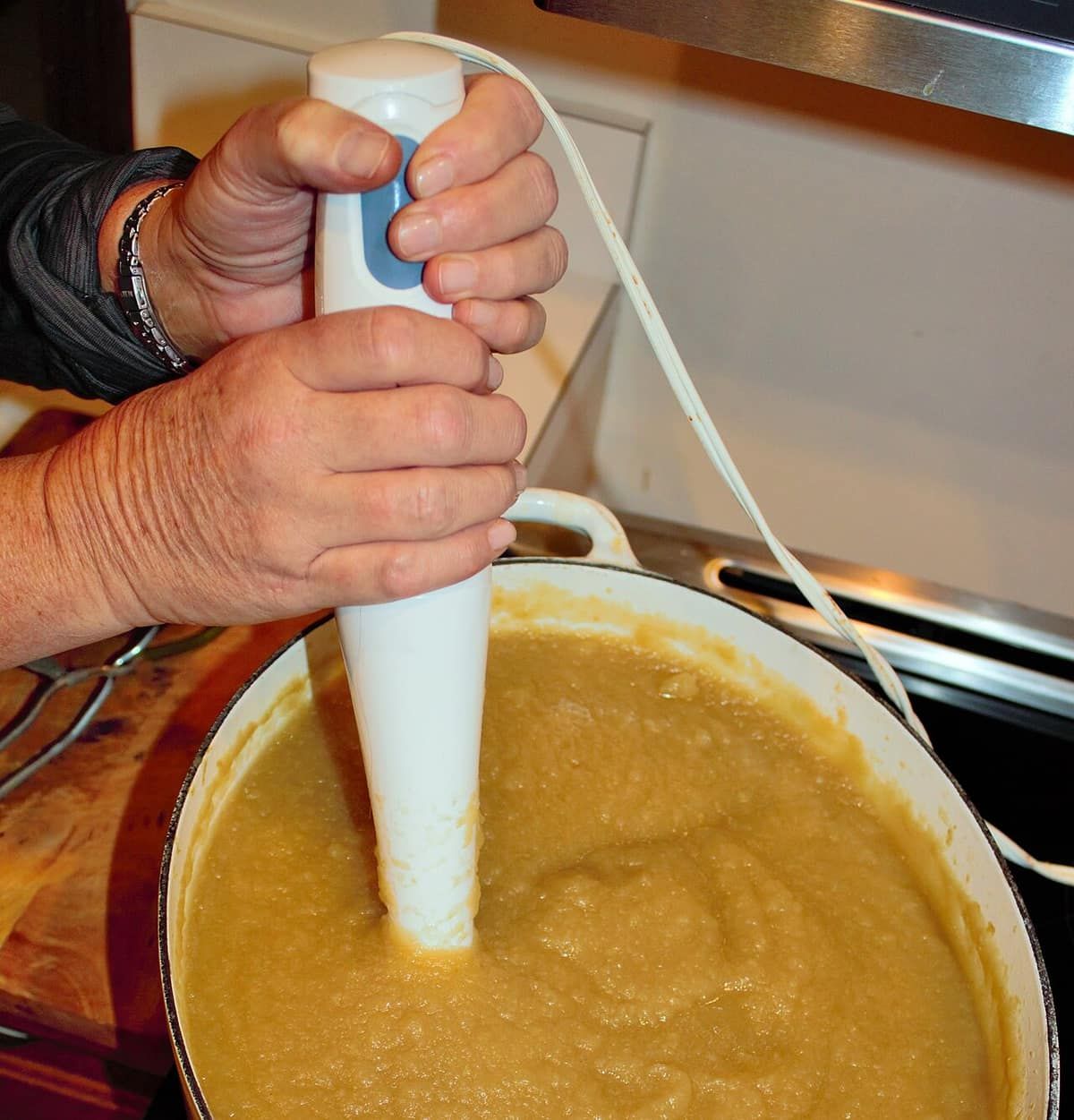
Cooling first works on any blender and is the only option Ninja’s BL660 guide allows. Tasting Table, citing Cuisine at Home, calls an immersion blender the safest method for hot soup. No blender manual I read covers immersion blenders, so that is editorial advice, not a manufacturer’s.
If your blender shuts itself off mid-blend, the motor has likely overheated. nutribullet’s guide describes an internal thermal breaker, and TechGearLab reports blenders turning off partway through soup to cool the motor. See why a blender smells like burning.
If the lid blew off: burns, cracks and recall status
Burns come first. Follow Mayo Clinic’s burn first-aid guide, which lists the signs that mean you should call 911 or go to the emergency room. For anything beyond a minor burn, get medical help.
Then check the container and lid for cracks before using them again. Note the model number and check it against our blender recall check.
The CPSC Recall API, checked on 2026-10-04, lists no blender recall for a hot-liquid, steam or burn hazard. The blender recalls it lists are for laceration, fire or broken-blade injury hazards. BlendJet 2, for example, was recalled for fire and laceration hazards, not hot contents.
How we researched this
I read the Vitamix 5200 manual, nutribullet’s NBF50500 user guide, Ninja’s BL660 owner’s guide, the Philips and KitchenAid FAQs, TechGearLab’s blender comparison, the CPSC Recall API, the TODAY report, and the Tasting Table and Daily Meal articles. Nothing here comes from hands-on use. See how we research.
Related blender guides and comparisons
- Best blenders
- Personal vs full-size blender
- Vitamix 5200 vs Ninja BN701
- nutribullet NBF50500 vs Ninja BN701
- Blender recall check
- Why a blender smells like burning
Frequently asked questions
Can you put hot liquid in a blender?
Only if your blender's manual allows it. Vitamix's 5200 manual and nutribullet's Combo pitcher guide allow hot liquids with the lid and vented cap or plug locked, the container below max, and the lowest speed to start. Ninja's BL660 Professional owner's guide says do not blend hot liquids. nutribullet's guide bans hot liquid in sealed personal cups.
Can you blend hot liquid in a nutribullet?
In the Combo pitcher, yes; in the cups, never. nutribullet's NBF50500 guide says hot ingredients can pressurize a sealed cup and violently expel hot contents, so cup ingredients should start at 70°F or cooler. The pitcher allows hot liquids only with its lid and vented lid cap locked, ingredients below the MAX line, and blending started on LOW.
How hot is too hot to blend?
Philips is the only manufacturer we found that gives a degree figure for a jar: cool ingredients below 60°C, or 140°F, to avoid damaging the jar and its accessories. Vitamix, nutribullet and KitchenAid give no temperature for their pitchers, and Ninja's BL660 guide says to cool soups to room temperature. For nutribullet's sealed cups, ingredients should start at 70°F or cooler.
Why did my blender lid blow off with hot soup?
The Daily Meal, citing Food Network, says hot liquids expand as they blend and steam pressure can push the lid off. nutribullet's guide says heated ingredients can pressurize a sealed container, and Vitamix's 5200 manual says to lock the lid so expansion does not shift it. Vitamix also says never to start above speed 1 with hot liquids, to avoid possible burns.
Should you remove the center cap when blending hot liquids?
Not if your manual says keep it in. Vitamix's 5200 manual says to run with the lid and lid plug firmly in place, removing it only to add ingredients or use the tamper. nutribullet says the pitcher's vented lid cap must be locked because it lets steam and pressure escape, and KitchenAid's FAQ says its vented cap should stay in place. The Daily Meal's remove-the-cap-and-hold-a-towel tip conflicts with these manuals.
Sources
- mayoclinic.org/first-aid/first-aid-burns/basics/art-20056649
- vitamix.com/media/catalog/product/file/Vitamix-5200-Owners-Manual.pdf
- nbmedia.imgix.net/NBF50500_BlenderCombo_UserGuide_English_LoRes_PROOF_F20221010.pdf
- images.thdstatic.com/catalog/pdfImages/e1/e198b89e-4836-47c7-b47c-f89a37de87fa.pdf
- usa.philips.com/c-f/XC000006081/can-i-pour-boiling-hot-liquids-into-the-jar-of-my-philips-blender
- kitchenaid.co.uk/faq/blending-hot-liquids
- techgearlab.com/topics/kitchen/best-blender
- saferproducts.gov/RestWebServices/Recall
- today.com/food/nutribullet-users-say-blenders-are-exploding-causing-burns-t119477
- tastingtable.com/835657/the-reason-you-shouldnt-put-hot-liquid-in-a-blender
- thedailymeal.com/1171716/why-you-should-never-mix-hot-liquid-in-a-blender