Coffee to Water Ratio for Drip Coffee Maker: Grams & Cups
The coffee to water ratio for a drip coffee maker is 55 g per liter, about 1:18. Why machine cups are 4 or 5 oz, and doses by pot size.
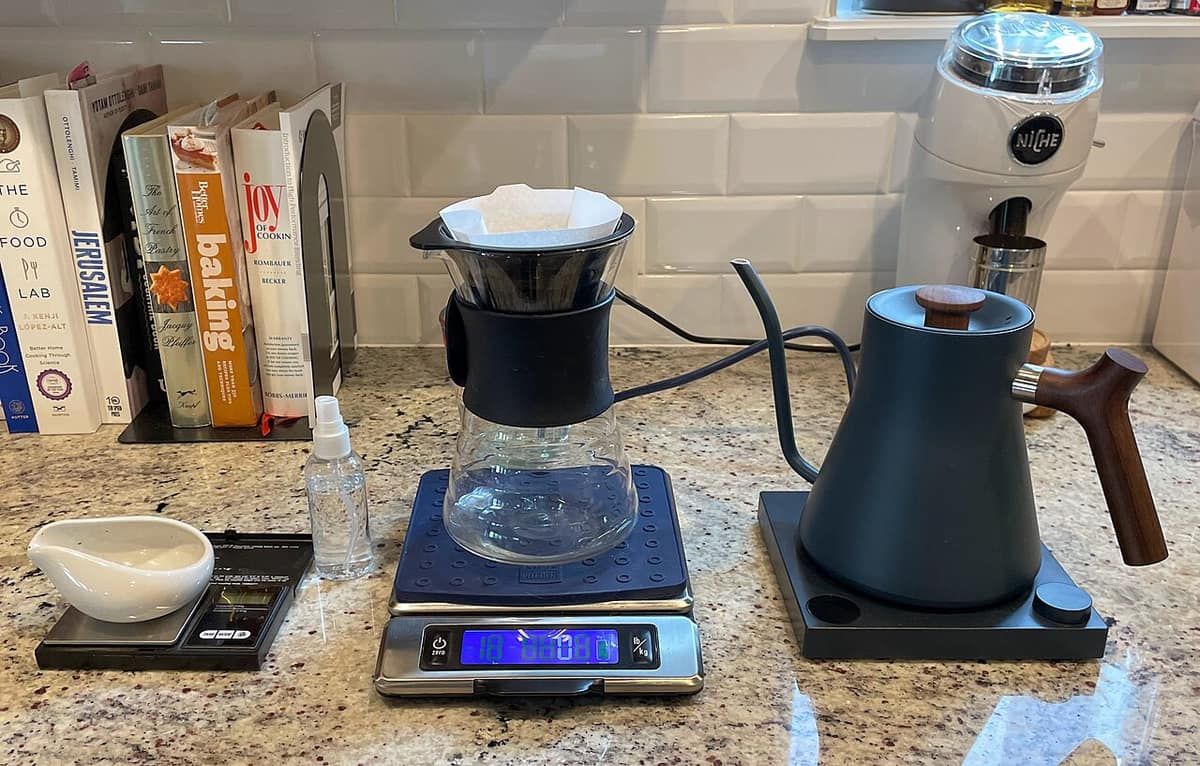
The coffee to water ratio for a drip coffee maker, by the Specialty Coffee Association’s Golden Cup figure, is 55 g of ground coffee per liter of water. America’s Test Kitchen used that dose and calls it a 1:18 ratio. The National Coffee Association’s volume version is 1 to 2 tablespoons per 6 oz of water. In the manuals I checked, a machine’s “cup” is 4 or 5 oz, not a mug, so measure by water, not cups.
Grams of coffee per liter: what the SCA and NCA say, and where they disagree
The SCA figure for grams of coffee per liter, as America’s Test Kitchen and the Moccamaster manual report it, is 55 g/L. Here is who says what:
| Source | Recommended dose | Notes |
|---|---|---|
| SCA Golden Cup, per America’s Test Kitchen | 55 g per liter, “a 1:18 ratio for the pot” | Medium to medium-fine grind |
| Moccamaster user guide (manufacturer spec) | 2 tbsp per 6 oz, “or 55 grams” per liter | Calls it the SCA-approved standard |
| OXO Brew 8-Cup manual (manufacturer spec) | About 8 g per 5 fl oz cup | Says it’s based on the SCA Golden Cup Standard |
| National Coffee Association | 1 to 2 tbsp per 6 oz of water | About 5 minutes of contact, medium grind |
Moccamaster treats 2 tablespoons per 6 oz and 55 g per liter as the same thing. The NCA’s range starts at half that, 1 tablespoon. Converting tablespoons to grams is shaky: ATK says ground coffee has “radically different weights and volumes” depending on roast and grind.
One sourcing caveat. The SCA’s own standards page doesn’t publish a brew ratio; its home-brewer standard, SCA-310, is open only to members. So the 55 g/L figure reaches readers through ATK and the manuals above, not a public SCA document. For what the SCA badge itself checks, see what the SCA badge actually tests.
How many ounces is a “cup” on a coffee maker?
A coffee maker cup is 4 or 5 fl oz in the manuals below, not an 8-oz mug. Every figure is a manufacturer spec:
- Moccamaster: the dosing table carries the note “European Cup size: 4oz”, so the 10-cup Moccamaster KBT holds 40 oz, or 1.25 L.
- Ninja CE251: the 12-Cup Line is 60 fl oz, per Ninja’s owner’s guide. That works out to 5 oz per cup.
- OXO Brew 8-Cup: one cup is 5 fl oz, so 8 cups are 40 oz, or 1,183 mL.
- Cuisinart DCC-3200: the Canadian DCC-3200C booklet says “1 level scoop of ground coffee per cup” and caps grounds at 15 tablespoons. It doesn’t say how big a cup or the scoop is, so I can’t convert its chart to grams.
America’s Test Kitchen ran into the same mess: it notes that the Zojirushi ZUTTO brews five “cups” totaling about 20 oz. The practical upshot is that “10 cups” is 40 oz on a Moccamaster and 50 oz on a 5-oz-cup machine. That’s a 25% difference in water, so a ratio only works if you know which cup your machine means.
How much coffee for 10 cups (and 4, 8 and 12)
How much coffee for 10 cups depends on the machine: 69 g on a Moccamaster KBT, or 10 tablespoons on a Ninja CE251. This table holds only numbers printed in each manual.
| Machine (manual) | What one “cup” means (manufacturer spec) | Full-pot water (manufacturer spec) | Coffee for a full pot (manufacturer spec) | Scoop size (manufacturer spec) | Smallest recommended brew / small-batch setting (manufacturer spec) | Source |
|---|---|---|---|---|---|---|
| OXO Brew 8-Cup | 5 fl oz | 8 cups, 40 oz / 1,183 mL | 64 g (8 scoops); chart runs 16 g for 2 cups up to 64 g, 8 g per cup | About 8 g | Chart starts at 2 cups, 10 oz / 296 mL | OXO manual |
| Moccamaster KBT | 4 oz (European cup) | 10 cups, 40 oz / 1.25 L | 69 g (7 level scoops); 4-cup 28 g, 6-cup 41 g, 8-cup 55 g, 15-cup 99 g | 2 tbsp | Minimum 4 cups (16 oz) in 8- to 10-cup brewers | Moccamaster user guide |
| Ninja CE251 | Not published in oz; 12-cup line is 60 fl oz | 12 cups, 60 fl oz | 12 Ninja scoops or 12 tbsp; 1 scoop per cup from 2 cups up | 1 tbsp | Small Batch for 4 cups or fewer | Ninja owner’s guide |
| Cuisinart DCC-3200 | Not published | 14 cups; oz not published | 1 level scoop per cup; 15 tbsp maximum | Not published | 1–4 cup button for fewer than 5 cups | DCC-3200C booklet |
Our arithmetic, not the manufacturers’: OXO’s 64 g in 1,183 mL is about 54 g/L, and Moccamaster’s 69 g in 1.25 L is about 55 g/L. Both land within about 1 g/L of the 55 g/L figure.
Not every guide agrees with the manufacturers. Coffee Circle, a coffee retailer, gives 81 g for 1.25 L in a Moccamaster, which by our math is about 65 g/L. That’s roughly 18% above 55 g/L and 12 g more than Moccamaster’s own 69 g.
Coffee scoop vs scale: which is more accurate?
A scale is more consistent, per America’s Test Kitchen, and part of the reason is that brands’ scoops differ. Per their manuals, Ninja’s integrated scoop is 1 tablespoon, Moccamaster’s is 2 tablespoons, and OXO’s holds about 8 g. “One scoop per cup” on a Ninja is half the coffee of one scoop per cup on a Moccamaster, before cup size even enters.
ATK found the scoops that came with the machines it reviewed “misleading” and recommends weighing coffee on a kitchen scale instead.
If you don’t own a scale, follow your own machine’s scoop chart rather than a generic “2 tablespoons per cup” rule. OXO’s scoop is the only one of the four that its maker sizes in grams, and OXO says its 8 g per cup chart is based on the SCA Golden Cup Standard. More in our OXO Brew 8-Cup review.
How do you make drip coffee stronger without adding more grounds?
- Moccamaster: if coffee is too strong, add hot water to your cup. If it’s too weak, the guide says “DO NOT add more coffee” and suggests a different roast profile or growing region instead.
- Ninja CE251: for stronger coffee, use the Rich setting, a darker roast or the permanent filter instead of paper. You can also add more grounds, but Ninja warns they absorb water, so you get more concentrated coffee and less of it. Too many grounds can overflow the filter holder. More in our Ninja CE251 review.
- Cuisinart DCC-3200: press Bold for stronger flavor, and stay at or under 15 tablespoons of grounds or the basket may overflow if the coffee is finely ground.
So Moccamaster says don’t add coffee and Ninja says you can. Strength buttons draw a third view: America’s Test Kitchen advises against “Strong” or “Bold” settings, saying they lengthen the brew cycle and over-extract the grounds.
Small pots matter too. Moccamaster suggests a minimum of 4 cups (16 oz) in 8- to 10-cup brewers, and its notes for some models say partial pots “will result in under-extracted coffee.” Ninja’s Small Batch setting is for 4 cups or fewer, and the 14-cup Cuisinart has a 1–4 cup button for small pots.
What grind and water does each manual recommend?
- NCA: medium grind, “like kosher salt.”
- Moccamaster: medium to medium-coarse, and it warns most pre-ground bagged coffee is too fine for its brewers. It advises against reverse osmosis or distilled water, which it says can damage the boiling element.
- OXO: medium grind, filtered water, no distilled water.
- Cuisinart: medium-fine if you grind your own beans.
- Ninja: medium grind.
The manufacturers don’t agree on grind, from Cuisinart’s medium-fine to Moccamaster’s medium-coarse, so follow the one for your machine. If brewing slows over time, both the Moccamaster and Ninja manuals point to mineral scale; see how to descale a coffee maker.
Start at 55 g per liter, then adjust one thing
Start with 55 g per liter, or your machine’s own chart, and change one thing at a time. If you’re choosing a brewer, the best coffee makers hub ranks them by independent measurements and owner reports. For how we gather and check sources, see how we research.
More on drip coffee makers
- Best coffee makers
- OXO Brew 8-Cup review
- Moccamaster KBT review
- Ninja CE251 review
- What the SCA badge actually tests
- Why is my coffee maker slow?
Frequently asked questions
What is the golden ratio for drip coffee?
There are two, and they don't match exactly. The SCA Golden Cup figure, as reported by America's Test Kitchen and the Moccamaster manual, is 55 g of ground coffee per liter of water, which ATK calls a 1:18 ratio. OXO bases its 8 g per 5-oz cup on the same standard. The National Coffee Association's golden ratio is 1 to 2 tablespoons of ground coffee per 6 oz of water.
How much coffee for 10 cups in a drip coffee maker?
It depends on how big the machine's cup is. Moccamaster's manual uses a 4-oz European cup, so its 10 cups are 40 oz of water and take 69 g, or 7 level scoops. On a machine with 5-oz cups, 10 cups are 50 oz. Ninja's CE251 chart calls for 10 Ninja scoops, or 10 tablespoons, at the 10-cup line.
How many scoops of coffee for a 12-cup coffee maker?
On the Ninja CE251, 12 Ninja scoops, or 12 tablespoons, for water at the 12-cup line, which Ninja's owner's guide puts at 60 fl oz. Other brands use different scoops: Moccamaster's holds 2 tablespoons and OXO's holds about 8 g, so check the chart for your own machine rather than counting scoops from another brand.
Should I use a coffee scoop or a scale?
A scale is more consistent. America's Test Kitchen found the scoops that came with coffee makers misleading, because ground coffee's weight per volume changes with roast and grind, and it recommends weighing. Without a scale, use your own machine's scoop and chart: OXO says its scoop holds about 8 g, Ninja's is 1 tablespoon and Moccamaster's is 2.
How many ounces is a cup on a coffee maker?
Usually 4 or 5 fl oz, not an 8-oz mug. OXO's manual defines a cup as 5 fl oz, and Ninja's CE251 marks 12 cups at 60 fl oz, which is also 5 oz each. Moccamaster uses a 4-oz European cup. Cuisinart's Canadian DCC-3200C booklet doesn't state its cup size in ounces.
Sources
- americastestkitchen.com/equipment_reviews/2461-best-coffee-makers-automatic-drip
- aboutcoffee.org/brewing/drip-coffee
- oxo.com/media/wysiwyg/PDF_Files/Brew_8718800_8CupCoffeeMaker_Manual_M03_Web.pdf
- williams-sonoma.com/netstorage/pdf/Technivorm-Moccamaster-KBG-Select-Manual.pdf
- images.thdstatic.com/catalog/pdfImages/da/da60176b-126f-490a-b1a4-f1bd1654c887.pdf
- cuisinart.ca/on/demandware.static/-/Sites-master-ca/en_CA/v1775984659605//Instruction%20Booklet/DCC-3200C.pdf
- coffeecircle.com/en/e/moccamaster-coffee-machine-how-to
- sca.coffee/research/coffee-standards