Pressurized vs Non-Pressurized Basket: Which to Use
Dual wall baskets forgive pre-ground coffee; single wall baskets need an espresso grinder. What the manuals say and which machines ship which.
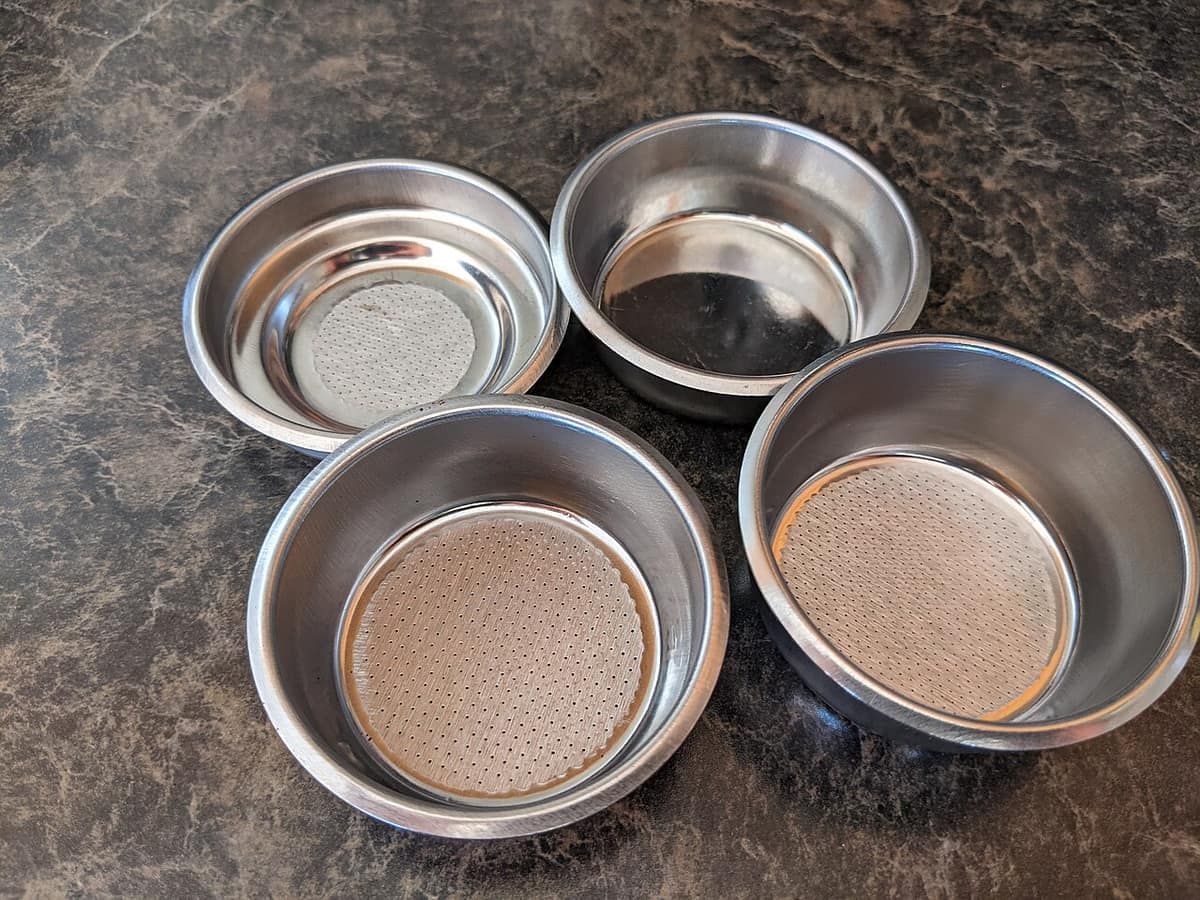
The difference in a pressurized vs non-pressurized basket is where the resistance comes from. A pressurized (dual wall) basket has a perforated inner wall over an outer wall with one small exit hole, which creates back-pressure so coarse or stale coffee still makes a shot. A non-pressurized (single wall) basket gets nearly all its resistance from the coffee puck, so it needs a fine, fresh grind. Breville’s BES870 and BES500 manuals give the rule: dual wall for pre-ground, single wall for freshly ground beans.
Pressurized portafilter explained: how each basket works
Breville’s own explainer describes the dual wall layout. The inner wall has many holes, and the outer wall has “a single, small hole at the base.” Some have a few small holes, but always far fewer than the inner wall. Forcing water through that hole creates back-pressure that, in Breville’s words, “compensates for inconsistencies” such as uneven tamping or the wrong grind size.
Not every pressurized basket is built the same way. Seattle Coffee Gear says some use “a small chamber with offset holes” and others a smaller set of holes centered in the basket. Coffeeblog.co.uk describes the usual layout as a varying number of holes on the first layer and a single small hole on the bottom layer.
A single wall basket has no restriction of its own. “In an unpressurized basket, nearly all of the resistance is created by the coffee, not by the basket,” Seattle Coffee Gear writes.
The pump’s bar rating is a separate topic; see espresso machine bar pressure explained.
Single wall vs double wall basket: side-by-side
| Attribute | Pressurized (dual wall) basket | Non-pressurized (single wall) basket | Source |
|---|---|---|---|
| Wall layout | Perforated inner wall, outer wall with one or a few small holes | One wall, perforated across the floor | Breville explainer |
| Where resistance comes from | The basket’s exit hole | Nearly all from the coffee puck | Seattle Coffee Gear |
| Coffee the maker says to use | Pre-ground, or beans past 30 days off roast (manufacturer spec) | Fresh whole beans roasted less than 30 days ago (manufacturer spec) | BES500 manual |
| Grind tolerance | Optimizes extraction “regardless of the grind, dose, tamp pressure or freshness” (manufacturer claim) | Lets you “experiment with grind, dose and tamp” (manufacturer claim) | BES870 manual |
| Dose, Breville Barista Express | 1 cup about 8-10 g, 2 cup about 15-18 g (manufacturer spec, same for both types) | 1 cup about 8-10 g, 2 cup about 15-18 g (manufacturer spec) | BES870 manual |
| Dose, Breville Bambino Plus | 1 cup 8-11 g, 2 cup 16-19 g (manufacturer spec, same for both types) | 1 cup 8-11 g, 2 cup 16-19 g (manufacturer spec) | BES500 manual |
| Flavor and crema | “Might not produce the same full-bodied flavor,” but more consistent shots with rich crema (manufacturer claim) | Can give “professional-quality espresso shots” with practice and a good burr grinder (manufacturer claim) | Breville explainer |
| Control | Less; “generally better for beginner” brewers | More; needs a fine grind and even tamp | Breville explainer |
What the manufacturers say about each basket
Breville’s BES870 manual says it plainly: “Use Dual Wall filter baskets if using pre-ground coffee.” Single wall baskets are for “grinding fresh whole coffee beans.”
The same manual has a useful note on volume. In the 2 cup basket, pre-ground coffee is about 3 level scoops and fresh ground about 4, because “pre-ground coffee is often coarser and hence occupies more volume.” So the scoop count changes when you switch, even though the target weight doesn’t.
The BES500 manual for the Bambino Plus adds a freshness cutoff. Single wall baskets are for beans “roasted less than 30 days,” and dual wall baskets for pre-ground coffee and “older beans that are past the 30 day roast date.”
De’Longhi’s EC260 manual for the Stilosa lists a one-shot filter “suitable for ESE pod” and a two-shot filter. Its troubleshooting section says to “use only pre-ground coffee for espresso coffee makers.” The manual never calls its filters pressurized, so that detail comes from Coffee Chronicler below.
Which baskets come with popular espresso machines
| Machine | Portafilter size | Baskets in the box | Source |
|---|---|---|---|
| CASABREWS CM5418 | 51 mm | One-shot and two-shot, both pressurized | TechRadar; Tom’s Guide (Bashford) |
| De’Longhi Stilosa | 51 mm (implied) | EU and Asia: also a non-pressurized basket; US contents implied pressurized only | Coffee Chronicler |
| Breville Bambino Plus | 54 mm (manufacturer spec) | Single and dual wall, 1 cup and 2 cup | BES500 manual; Tom’s Guide; TechGearLab |
| Breville Barista Express | 54 mm (manufacturer spec) | Single and dual wall, 1 cup and 2 cup | BES870 manual |
| Gaggia Classic E24 Evo Pro | 58 mm | Two single wall baskets plus one pressurized | Tom’s Guide |
TechRadar found that the CASABREWS CM5418 basket locks in with a notch threaded into the portafilter rather than the usual spring clip. TechRadar also wrote that “not even on the Casabrews website” could it find single wall baskets that fit the stock portafilter. Its conclusion was that switching means buying a whole new portafilter.
The Breville Bambino Plus is where sources disagree. The US BES500 manual says it “includes both single and dual wall 1 Cup and 2 Cup filter baskets,” and Tom’s Guide describes four included standard and dual-walled baskets. TechGearLab lists four filter baskets for both the Bambino and Bambino Plus. Coffee Chronicler, in its Bambino Plus entry, says “the Bambino” “only comes with a pressurized basket,” adding that units sold as Sage include a single wall basket as well.
We side with the manual for current US Bambino Plus units, since three sources agree with it, but check the box contents for your exact model.
For the De’Longhi Stilosa, Coffee Chronicler says “in the EU and Asia, you also get a genuine, non-pressurized espresso basket as standard,” and suggests US owners buy a 51 mm portafilter and a premium basket, which implies US units ship without one. It doesn’t state the US contents outright, and De’Longhi’s EC260 manual doesn’t say whether its filters are pressurized.
The Breville Barista Express ships with all four baskets, per its BES870 manual. Tom’s Guide calls the Gaggia Classic’s 58 mm portafilter “the commercial standard.”
Do I need a non-pressurized basket?
- No grinder, or you buy pre-ground: stay with the dual wall basket. Both Breville manuals say so, and Tom’s Guide’s Erin Bashford says pressurized baskets are for people without a grinder that can grind espresso-fine.
- Beans past 30 days off roast: dual wall, per the BES500 manual, even if you grind them fresh.
- A burr grinder that reaches espresso-fine, and beans under 30 days off roast: switch to single wall, per the BES500 manual and Bashford.
Enthusiast writers go further. Coffee Chronicler’s Asser Christensen says pressurized portafilters “should be avoided if you’re serious about learning the barista craft,” and Bashford takes the same line for anyone getting serious about espresso. That is an informed opinion, not a measured result.
Does a pressurized basket ruin the shot? What the measurements show
The evidence is thin. TechGearLab measured extraction yield with a refractometer: 20.7% on the CASABREWS CM5418, which it called “virtually perfect,” and 12% on the De’Longhi Stilosa in its comparison table. TechGearLab gives 18 to 22 percent as the ideal yield. The CM5418 ships only with pressurized baskets, per TechRadar.
TechGearLab doesn’t say which basket it used for each shot. Neither result can be pinned on the basket type, and no source we read published measurements comparing the two basket types on the same machine.
The “fake crema” claim is opinion too. Coffeeblog.co.uk says pressurized baskets “ensure the illusion of good extraction by creating artificial crema,” though it finds the Bambino Plus pressurized basket less synthetic-looking than some. Seattle Coffee Gear says they “create less perfect espresso” but are less finicky.
Before you buy an upgrade basket: size and fit
- Match the diameter. The CM5418 is 51 mm (TechRadar), the Stilosa 51 mm (Coffee Chronicler), Breville’s Bambino Plus and Barista Express 54 mm (Breville manuals), and the Gaggia Classic 58 mm (Tom’s Guide).
- Check how the basket is held. A spring clip is the usual method, per TechRadar; the CM5418 uses a notch instead, and TechRadar couldn’t find a compatible single wall basket even on Casabrews’ own site.
- Expect to dial in again. Breville’s BES870 manual says a finer grind in single wall baskets may need a higher grind amount to dose the basket correctly.
- A bottomless portafilter is a separate purchase. It replaces the whole portafilter, so the same size and fit points apply.
More on espresso machines
- Best espresso machines
- CASABREWS CM5418 review
- Breville Bambino Plus review
- De’Longhi Stilosa review
- Breville Barista Express review
- CASABREWS CM5418 vs De’Longhi Stilosa
- Espresso machine bar pressure explained
- How we research
Frequently asked questions
Is a double wall basket the same as a pressurized basket?
Yes. Dual wall, double wall and pressurized are names for the same basket, and single wall means non-pressurized. Breville's explainer uses the terms interchangeably, and Tom's Guide's Erin Bashford calls them synonyms. The extra outer wall has one small hole, or a few, and that is what creates the back-pressure.
Can I use pre-ground coffee in a single wall basket?
You can, but the manufacturers say not to. Breville's BES870 and BES500 manuals tell you to use the dual wall basket with pre-ground coffee, because a single wall basket gets its resistance from a fine, fresh grind. Breville notes that pre-ground coffee is often coarser and takes up more volume.
How do I tell if my basket is pressurized?
Look at the underside. A pressurized basket has a second, outer wall with a single small hole or a few holes, per Breville's explainer, while a single wall basket shows many tiny holes across the whole floor. If your machine came with only one kind, Tom's Guide's Erin Bashford suggests checking for one tiny hole versus many sieve-like holes.
Which basket should I use with ESE pods?
On the De'Longhi Stilosa, use the one-shot filter. De'Longhi's EC260 manual lists that filter as suitable for ESE pods and tells you to use it if you use pods; the two-shot filter carries no such note. Breville's BES870 and BES500 manuals don't mention pods. Check your own machine's manual before putting a pod in any other basket.
Why do I need more coffee in a single wall basket?
You need more scoops, not more grams. Breville's BES870 manual puts about 3 level scoops of pre-ground in the 2 cup basket against about 4 of fresh ground, because pre-ground is coarser and takes up more space. Breville adds that with a finer espresso grind in the single wall baskets you may need to increase the grind amount to dose the basket correctly.
Sources
- breville.com/content/dam/breville/us/assets/miscellaneous/instruction-manual/espresso/BES870-instruction-manual.pdf
- assets.breville.com/BES500/BES500_USCM_IB_T23_LR.pdf
- static.pcrichard.com/docs/EC260BK_Owners-Manual_01.pdf
- breville.com/us/en/blog/coffee-and-espresso/pressurized-vs-non-pressurized-portafilter.html
- techradar.com/home/coffee-machines/casabrews-cm5418-review
- tomsguide.com/reviews/breville-sage-bambino-plus
- tomsguide.com/home/coffee-makers/gaggia-classic-e24-evo-pro-review
- tomsguide.com/home/coffee-makers/single-vs-dual-walled-baskets-whats-best-for-your-espresso-at-home
- coffeechronicler.com/gear/espresso-machines
- seattlecoffeegear.com/blogs/scg-blog/pressurized-vs-unpressurized-whats-the-difference
- coffeeblog.co.uk/pressurised-portafilter-baskets
- techgearlab.com/topics/kitchen/best-espresso-machine