Espresso Machine Bar Pressure Explained: 9, 15 or 20 Bar?
A 15- or 20-bar rating is the pump's maximum, not brew pressure. What 9 bar means, how pressurized baskets affect the gauge, and what to check instead.
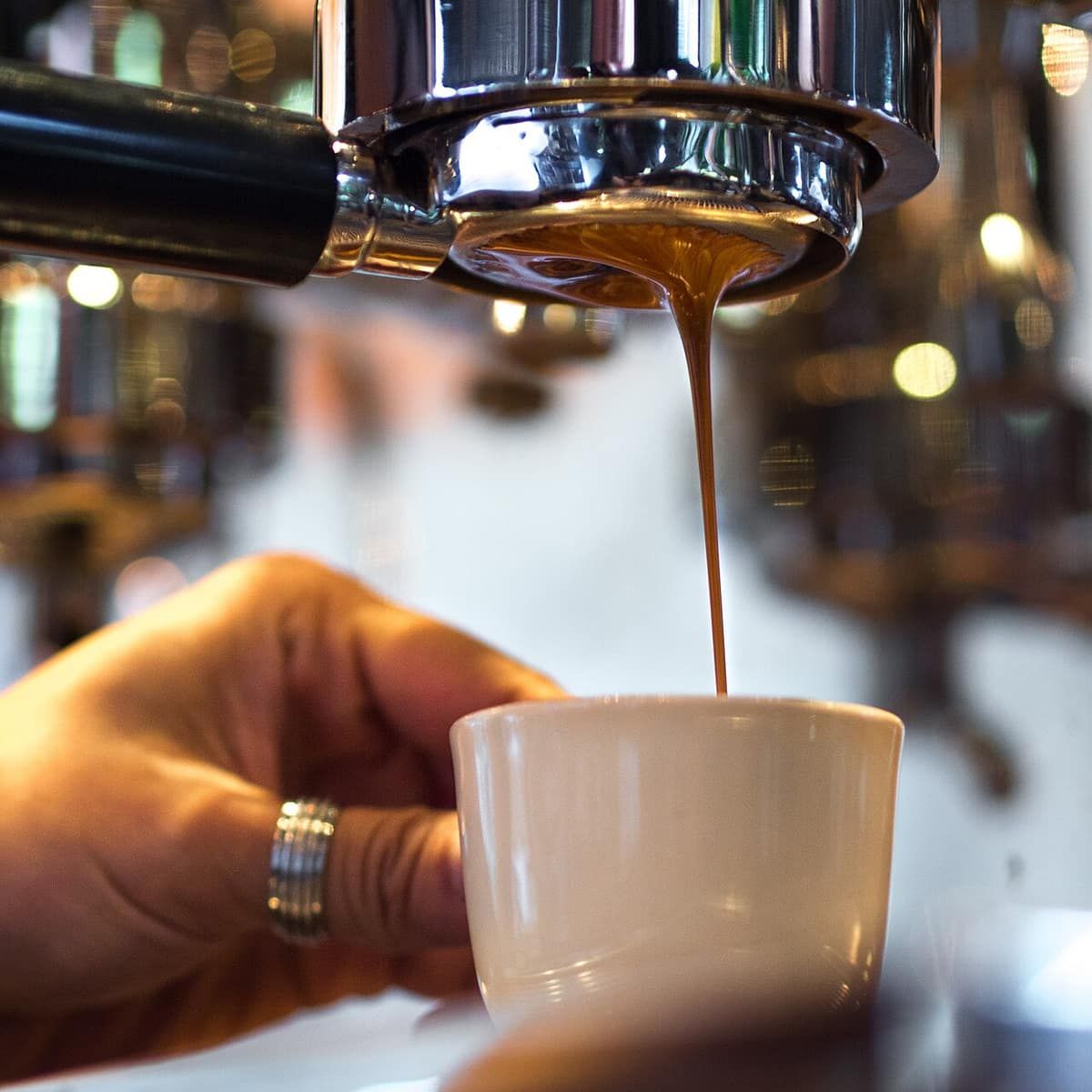
Espresso machine bar pressure explained in one line: the 15 or 20 bar printed on the box is the most the pump can produce, not the pressure your coffee brews at. Reference espresso brews near 9 bar at the puck. The Italian Espresso National Institute’s spec, as reproduced in Wikipedia’s Espresso article, sets it at 9 ± 1 bar. A 20-bar pump doesn’t make better espresso on its own.
What decides the pressure the coffee actually sees is the puck, the basket and, on some machines, a valve that bleeds off the excess. Everything below comes from manufacturer manuals and independent reviewers; how we research explains why we don’t test hands-on.
What one bar of pressure means, and how espresso settled on 9
One bar is 100 kilopascals; Wikipedia gives the 9 bars of a classic pump machine as 900 kPa. That is roughly nine times the air pressure at sea level, or about 130 psi.
Wikipedia’s history of espresso shows how the number settled. Early steam machines from Bezzera and Pavoni made about 1.5 bar, which the article calls too little for modern espresso. Gaggia’s 1947 lever machine pushed water at up to 12 atmospheres, and the 1961 Faema E61 used an electric pump that pressurized water to 9 bar, the same figure the Italian standard below uses.
What bar pressure is right for espresso?
The Italian standard is a definition of what counts as espresso, not a measurement of any machine. Here are the parameters as reproduced on Wikipedia:
| Parameter (INEI standard) | Value |
|---|---|
| Water pressure entering the coffee | 9 ± 1 bar |
| Water temperature leaving the machine | 88 ± 2 °C |
| Percolation time | 25 ± 5 s |
| Temperature in the cup | 67 ± 3 °C |
Not every source treats 9 bar as the only right answer. Coffee Chronicler says espresso should be brewed at around 6 to 9 bar and notes a movement away from high pressure, with around 6 to 7 bar now the preferred setting. Nine bar is the reference, and lower pressure is an accepted alternative, not an error.
Pump rating vs brew pressure: 9 bar vs 15 bar espresso machines
The box figure is a pump rating. CASABREWS lists a 20-bar Italian pump for the CM5418 (manufacturer spec). De’Longhi’s Stilosa EC260BK page lists “Pump Pressure (bar): 15” (manufacturer spec). Breville’s BES870 Barista Express manual calls its pump a “15 bar Italian pump” (manufacturer spec).
Even GEVI, a brand that sells 20-bar machines, says on its blog that the rating is the pump’s maximum pressure capacity, not the brewing pressure. Homegrounds makes the same point: what matters is the pressure at the group, where the water hits the coffee. With a regular basket, that depends on how much the coffee puck resists the water, as TechRadar puts it. On some machines an over-pressure valve, or OPV, also bleeds off pressure above its setting. So a 15-bar machine and a 9-bar machine can brew at similar pressure, or at very different pressure, depending on those parts.
Several ranking pages go further. GEVI says machines with 15- or 20-bar pumps deliver 9 bar during extraction, and Espresso Academy says an internal pressure regulator ensures only 9 bar reach the puck. Neither names the budget machines this applies to, and our sources don’t show it for them. Neither CASABREWS nor De’Longhi mentions an OPV or its setting on the pages we read. Tom’s Guide’s spec table for the Gaggia Classic E24 lists “OPV control: No”, meaning there’s no user adjustment.
Is a 20 bar espresso machine better?
No. A 20-bar rating says nothing reliable about the shot you’ll get, for three reasons:
- Brew pressure is set at the puck and the valve. The pump’s ceiling only matters if nothing else limits it.
- Independent results don’t follow the rating. TechGearLab measured extraction yield with a refractometer and calls 18 to 22% ideal. The CASABREWS CM5418 (20-bar spec) reached 21% and the Breville Barista Express (15-bar spec) 19.4%. The Bambino Plus reached 18.4%, the Bambino 18%, and the De’Longhi Stilosa (15-bar spec) 12%.
- The machines described as brewing at 9 bar are not the budget ones. See the next section.
One caveat: TechGearLab didn’t measure brew pressure. Its numbers show the bar rating doesn’t predict results; they don’t show pressure causing them. GEVI argues the extra power of a 20-bar machine may compensate for inconsistent grind size or tamping, but offers no measurements.
Which espresso machines brew at 9 bar?
Coffee Chronicler says the Breville Bambino Plus “brews at the correct 9 bars, instead of 15”. Breville’s BES500 manual gives no bar figure at all, so that claim rests on one reviewer. Our Breville Bambino Plus review and the Bambino vs Bambino Plus comparison cover the machine itself.
The Gaggia Classic is where sources conflict. Tom’s Guide says the Classic E24 Evo Pro “pulls at 9-bar”. Coffee Chronicler says many owners of the earlier Gaggia Classic Pro open the machine and install a special OPV spring to reach 9 bar. Both may be right for different model years, but no source we read confirms that.
Pressure gauges: what the needle tells you, and what it doesn’t
Breville’s BES870 manual (pp.16-17) describes four zones on the Barista Express gauge. The needle sits in a pre-infusion zone at the start; the solid grey Ideal Espresso Zone means ideal pressure; the lower zone means insufficient pressure and an under-extracted shot; the upper zone means too much pressure and an over-extracted shot. The manual gives no bar values for any zone. Our Breville Barista Express review has the rest of that machine’s record.
CASABREWS markets the CM5418’s gauge as a way to monitor each shot and fine-tune the brew (manufacturer claim). But TechRadar reports that both included baskets are pressurized, and that in a pressurized basket the extra wall, not the puck’s resistance, “does the heavy lifting” in regulating extraction pressure. CASABREWS’ own spec lists two dual-wall filters. So on that basket, a needle in the ideal range says more about the basket than about your grind. Our CASABREWS CM5418 review covers the machine in detail.
Grind isn’t the only cause of weak flow: Breville’s BES870 manual says hard-water mineral build-up reduces brewing flow, brewing temperature and the machine’s power. See CASABREWS CM5418 not pumping water and how to descale an espresso machine.
How do pressurized baskets change the pressure?
Breville’s BES870 and BES500 manuals say dual-wall baskets “regulate the pressure” and help optimize extraction regardless of grind, dose, tamp pressure or freshness. Both manuals point them at pre-ground coffee; the BES500 manual adds beans past 30 days from roast. Single-wall baskets, per the BES870 manual, let you experiment with grind, dose and tamp. Coffee Chronicler says pressurized portafilters “should be avoided” if you’re serious about learning the barista craft. Our guide to pressurized vs non-pressurized baskets explains how each type works.
Do pre-infusion and pressure profiling change brew pressure?
Both Breville manuals describe low-pressure pre-infusion that applies low water pressure at the start of extraction to gently expand the grinds. The BES870 manual adds that it “gradually increases water pressure” before full pressure. CASABREWS also lists low-pressure pre-infusion for the CM5418 (manufacturer claim). On the Bambino Plus, holding the 1 or 2 CUP button gives manual pre-infusion, per the BES500 manual.
Pressure profiling goes further: it changes pressure through the shot. None of our sources lists it for the machines in the table below. Coffee Chronicler notes the MiiCoffee Apex V2 has an externally adjustable OPV, so you can dial in 9 bar or go lower around 6 to 7. That is the kind of feature to look for if you want control over pressure.
Rated pump pressure vs what is known, machine by machine
Every figure below is a manufacturer spec or is credited to the reviewer who reported it. “Not published” means none of our sources states it.
| Machine | Rated pump pressure (manufacturer spec) | Brews near 9 bar? (source) | Adjustable OPV? (source) | Pressure gauge | Baskets included | Extraction yield measured by TechGearLab |
|---|---|---|---|---|---|---|
| CASABREWS CM5418 | 20 bar (manufacturer spec) | Not published | Not published | Yes (TechRadar; CASABREWS) | 1- and 2-shot, both pressurized (TechRadar) | 21% |
| De’Longhi Stilosa EC260BK | 15 bar (manufacturer spec) | Not published | Not published | Not listed by De’Longhi | Single and double filter; type not stated (De’Longhi) | 12% |
| Breville Bambino Plus BES500 | Not stated in Breville’s BES500 manual | Yes, per Coffee Chronicler; not in Breville’s manual | Not published | Not listed in BES500 manual | Single- and dual-wall, 1- and 2-cup (Korean-market BES500 manual); Coffee Chronicler says it ships with only a pressurized basket outside Sage-branded markets | 18.4% |
| Breville Barista Express BES870 | 15 bar (manufacturer spec, BES870 manual) | Not published | Not published | Yes, with Ideal Espresso Zone (BES870 manual) | Single- and dual-wall (BES870 manual) | 19.4% |
| Gaggia Classic E24 Evo Pro | Not published | Yes, per Tom’s Guide; Coffee Chronicler says earlier Classic Pro owners fit a spring to reach it | No user adjustment (Tom’s Guide) | Not listed by Tom’s Guide | Two single-wall, one pressurized (Tom’s Guide) | 17% for the “Gaggia Classic Evo Pro”; TechGearLab doesn’t say if it is the E24 |
What to check instead of the bar number
- An OPV, and its setting. Look for one set to, or adjustable to, about 9 bar. Few budget makers publish this.
- A non-pressurized basket in the box. Without one, grind and tamp matter less and the gauge tells you less.
- A pressure gauge, keeping the basket caveat above in mind.
- Pre-infusion, which both Breville manuals and CASABREWS describe.
- Your grind and tamp. Breville’s manuals say to tamp with about 15 to 20 kg of pressure, and that consistent pressure every time matters more than the amount.
Our espresso machine picks rank these machines by weight of evidence.
More espresso machine guides and reviews
- Best espresso machines
- De’Longhi Stilosa review
- Single vs double boiler espresso machines
- Pressurized vs non-pressurized baskets
- How we research
Frequently asked questions
How many bars of pressure do you need for espresso?
About 9 bar at the coffee puck. The Italian Espresso National Institute's parameters, as reproduced on Wikipedia, set entry water pressure at 9 ± 1 bar. Coffee Chronicler gives a wider range of 6 to 9 bar. A pump rated at 15 or 20 bar is a ceiling, not the pressure the coffee sees.
Is 15 bar or 20 bar better for espresso?
Neither is better on its own, because both figures describe the pump's maximum, not brewing pressure. TechGearLab's extraction measurements show no pattern by rating: the 20-bar-spec CASABREWS CM5418 reached 21%, while the 15-bar-spec De'Longhi Stilosa reached 12% and the 15-bar Breville Barista Express 19.4%.
Is a 9 bar espresso machine enough?
Yes, 9 bar matches the reference brewing pressure in the Italian espresso standard reproduced on Wikipedia. Coffee Chronicler says the Breville Bambino Plus brews at the correct 9 bars, and Tom's Guide says the Gaggia Classic E24 Evo Pro pulls at 9 bar. Breville's own BES500 manual does not state a bar figure.
What should the pressure gauge read when pulling a shot?
On the Breville Barista Express, the needle should sit in the solid grey Ideal Espresso Zone, according to Breville's BES870 manual. The lower zone means insufficient pressure and an under-extracted shot; the upper zone means too much pressure and an over-extracted one. The manual gives no bar numbers for the zones, so the gauge shows a range, not an exact pressure.
Is lower pressure (6-7 bar) espresso wrong?
No. Coffee Chronicler says espresso should be brewed at around 6 to 9 bar and notes a movement toward 6 to 7 bar. The Italian standard reproduced on Wikipedia uses 9 ± 1 bar as its reference, so lower pressure is an accepted alternative rather than a mistake.
Sources
- en.wikipedia.org/wiki/Espresso
- coffeechronicler.com/gear/espresso-machines
- breville.com/content/dam/breville/us/assets/miscellaneous/instruction-manual/espresso/BES870-instruction-manual.pdf
- assets.breville.com/BES500/BES500_KOR-EN_IB_C22_LR.pdf
- techgearlab.com/topics/kitchen/best-espresso-machine
- techradar.com/home/coffee-machines/casabrews-cm5418-review
- tomsguide.com/home/coffee-makers/gaggia-classic-e24-evo-pro-review
- delonghi.com/en-us/p/stilosa-stilosa-espresso-machine/EC260BK.html
- casabrews.com/products/cm5418
- homegrounds.co/how-many-bars-of-pressure-for-espresso
- gevi.com/blogs/buying-guide/15-bar-vs-20-bar-espresso-machines-what-you-need-to-know
- espressoacademy.it/en/guide-en/what-is-the-best-pressure-for-an-espresso-machine