Where to Put a Smoke Detector Near a Kitchen: 6, 10, 20 ft
Photoelectric: 6 ft from the stove. Ionization: 10-20 ft. See CPSC false-alarm rates by distance, when a heat alarm fits, and what never to do.
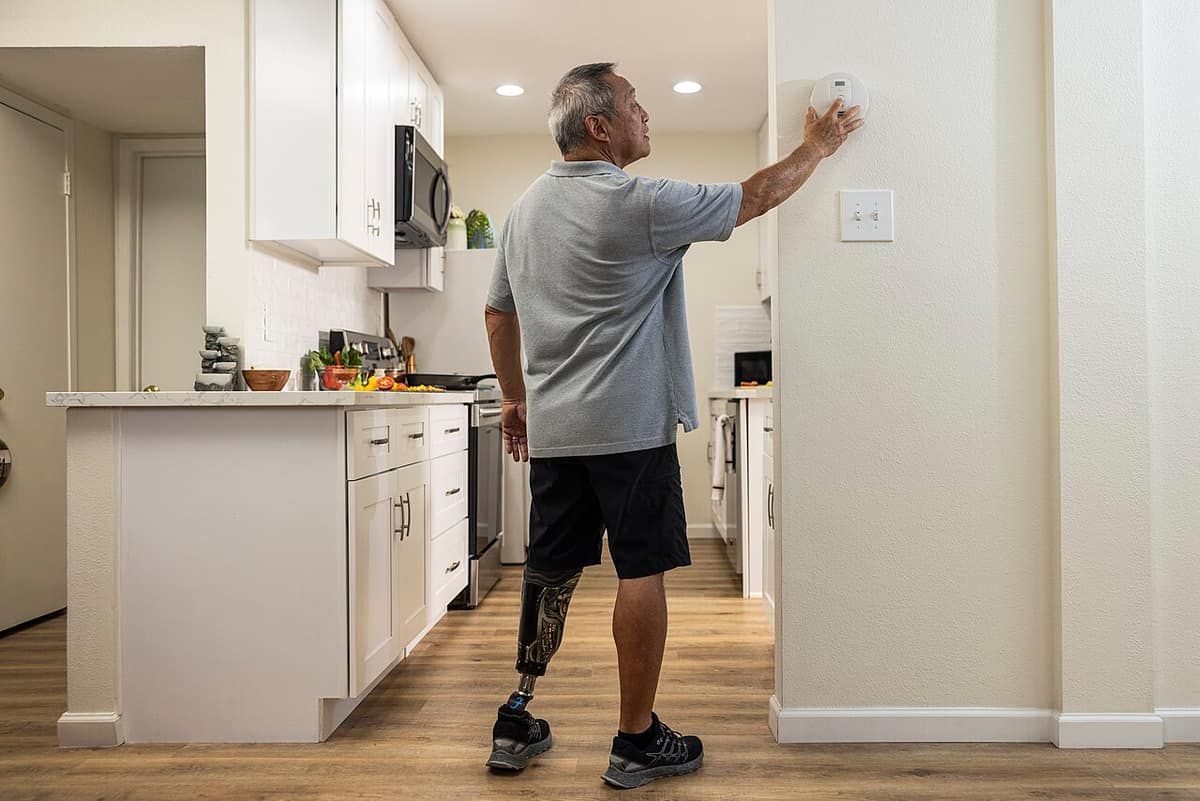
Where to put a smoke detector near a kitchen comes down to sensor type. Under the 2018 International Residential Code, section R314.3.1, a photoelectric alarm goes at least 6 ft horizontally from a permanently installed cooking appliance. An ionization alarm with a hush button needs at least 10 ft, and one without a hush button at least 20 ft. Mount it on the ceiling or high on a wall, never over the range.
This is a research summary of building code, CPSC field data and NIST and fire-service guidance. Nobody at Kitchen Watcher installed or tested alarms for it; see how we research.
Minimum distance from the stove by alarm type (the code rule)
Most smoke alarm distance-from-stove advice quotes one number, 10 ft or 20 ft, without saying which alarm it applies to. That is why the numbers conflict. The 2018 IRC R314 text, as reprinted by Boulder City, Nevada, splits it three ways:
- Ionization alarm: not less than 20 ft (6,096 mm).
- Ionization alarm with an alarm-silencing switch: not less than 10 ft (3,048 mm).
- Photoelectric alarm: not less than 6 ft (1,828 mm).
All three are measured horizontally from a permanently installed cooking appliance. The same section says these limits don’t apply if following them would prevent an alarm in a location the code requires, such as outside a bedroom. R314.1 and R314.1.1 also require smoke alarms to comply with NFPA 72 and be listed to UL 217.
Sources don’t fully agree. UL Standards & Engagement summarizes NFPA 72 as saying smoke alarms should be at least 10 ft from cooking appliances, which is stricter than the IRC’s 6 ft for photoelectric alarms. We did not open the NFPA 72 text itself. Local codes adopt different editions and add amendments, so check your local code and edition before you drill.
| Alarm type | Minimum horizontal distance from permanent cooking appliance (2018 IRC R314.3.1) | Nuisance-alarm rate at 5 ft (CPSC pilot) | Nuisance-alarm rate at 10 ft (CPSC pilot) | Nuisance-alarm rate at 20 ft (CPSC pilot) | Notes / source |
|---|---|---|---|---|---|
| Photoelectric | 6 ft | 3.0% | 6.0% | 0.9% | CPSC attributed the rise at 10 ft to data from one home |
| Ionization with silencing switch | 10 ft | 8.7% (all ionization) | 4.9% (all ionization) | 1.1% (all ionization) | CPSC did not split ionization alarms by hush button |
| Ionization without silencing switch | 20 ft | 8.7% (all ionization) | 4.9% (all ionization) | 1.1% (all ionization) | Strictest IRC distance |
| Dual-sensor | Not listed separately in R314.3.1 | 11.3% | 8.7% | 1.1% | Most nuisance alarms at 5 ft, per CPSC |
What the CPSC field study found at 5, 10 and 20 feet
The most direct field evidence we found is a CPSC staff pilot study by Arthur Lee and Danny Pineda. From March to November 2008, they put ionization, photoelectric and dual-sensor alarms 5, 10 and 20 ft from the stove in nine Washington, DC-area homes for about 30 days each.
Occupants logged 358 cooking events (469 after CPSC normalized for one home that had two sets of alarms). The paper was submitted to NFPA’s SUPDET conference in February 2010.
At 5 ft, nuisance alarms sounded during 8.7% of cooking events for ionization, 11.3% for dual-sensor and 3.0% for photoelectric. At 10 ft the rates were 4.9%, 8.7% and 6.0%. At 20 ft they fell to 1.1%, 1.1% and 0.9%.
The authors concluded that moving any type of alarm more than 10 to 15 ft from the stove considerably reduced nuisance alarms. Alarms 20 ft away rarely went off. Closer than that, photoelectric alarms produced the fewest. CPSC attributed the photoelectric bump at 10 ft to data from one home, where more exhaust-fan use and more stovetop frying may have been the cause.
Sautéing, pan-frying and stir-frying caused many more alarms than other cooking methods. CPSC mostly put that down to how often those methods were used. Dinner had the highest rate of any meal.
The authors list the limits themselves: nine volunteer homes not chosen at random, alarms from only two manufacturers, and no test of how well any alarm position detects a real cooking fire. Treat these as directional numbers, not precise odds.
Newer alarms are built to resist cooking smoke, up to a point
UL 217’s 8th edition took effect in 2024 and for the first time includes a cooking nuisance test, per NIST. NIST’s article gives the date as June 30, 2024 in its body and July 30 in its summary. UL Standards & Engagement describes it: alarms sit 10 ft from an electric range at full power while frozen hamburger patties broil, and they must not sound before the smoke reaches set thresholds.
NIST then cooked bacon, toast, grilled cheese and other foods near old and new alarms. Researcher Thomas Cleary said the new alarms “weren’t universally better” at staying quiet during cooking. His advice: if possible, place alarms at least 6 ft and ideally 20 ft from the cooking area, keep the home well ventilated, and use the hush button if all else fails. NIST also notes that stores can still sell older-standard stock and the new standard covers only newly made alarms, so a new purchase isn’t automatically an 8th-edition model.
How to mount it: ceiling, wall and small-kitchen placement
Placement guidance from BRK Electronics, a smoke-alarm maker owned by Resideo, labeled here as manufacturer advice:
- Keep alarms at least 20 ft from combustion sources such as the stove when possible; in small homes, as far as practical.
- Ceiling mount: as close to the center of the ceiling as possible, otherwise at least 4 in from the wall or corner.
- Wall mount, if your building code allows it: top edge between 4 and 12 in below the ceiling.
- Sloped ceiling: within 3 ft of the peak, measured horizontally.
- Avoid air streams near kitchens, which can pull cooking smoke into the sensor; fresh-air vents, ceiling fans and drafty spots, which can blow fire smoke away from it; and greasy areas.
- Avoid spots regularly below 40°F or above 100°F, and stay at least 12 in from fluorescent lights.
The International Association of Fire Chiefs also says 20 ft from cooking appliances, a hush button on the kitchen-area alarm, and 10 ft from bathrooms or other damp areas. The IRC’s hard minimum for bathrooms is 3 ft horizontally from the door of a room with a tub or shower.
In a studio or small apartment where 20 ft is impossible, BRK says to go as far from the stove as you can. The IRC allows a photoelectric alarm as close as 6 ft, and in the CPSC study photoelectric alarms had the fewest nuisance alarms when mounted closer than 10 to 15 ft; IAFC adds a hush button. Check local code first, since UL Standards & Engagement’s reading of NFPA 72 is 10 ft.
Should you use a heat alarm in the kitchen instead?
A heat alarm in the kitchen is standard advice in the UK, not the US. The London Fire Brigade says heat alarms go off when the room reaches a set temperature, should go in the kitchen instead of a smoke alarm, and won’t be set off by cooking fumes.
US guidance is different. The 2018 IRC requires smoke alarms, listed to UL 217, in each required location, so a heat alarm can’t stand in for a required smoke alarm.
The U.S. Fire Administration describes heat alarms as responding to high temperatures, not smoke, and recommends them for garages; it notes many models can interconnect with a home’s smoke alarms. So in a US home, a kitchen heat alarm can only be an addition, not a replacement. No alarm of either kind puts out a fire.
Where not to put a smoke detector near a kitchen
- Not directly over the range or stove (IRC R314.3.1 minimum distances; BRK).
- Not near air vents or ceiling fans, in drafty spots, or in air streams near the kitchen (BRK; IAFC).
- Not in steamy spots: BRK says at least 10 ft from showers, saunas and dishwashers, IAFC says 10 ft from bathrooms, and the London Fire Brigade warns steam can damage an alarm or set it off.
- Not in greasy areas near the cooktop (BRK; IAFC).
- Not in spaces below 40°F or above 100°F (BRK; IAFC).
Why does my smoke alarm go off when I cook, and what should I do?
Smoke detector false alarms from cooking push people to disable alarms. The CPSC paper says nuisance alarms are reported to be the leading cause of occupants disabling smoke alarms, and, citing NFPA, that nuisance alarms from cooking are the most commonly reported reason. The U.S. Fire Administration says to open a window or door and press the hush button, wave a towel at the alarm to clear the air, and move the entire alarm several feet away from the kitchen. Never remove the battery: USFA calls disabling an alarm or removing its battery a potentially deadly mistake.
Per NFPA data cited by UL Standards & Engagement, almost three in five home fire deaths in 2014-2018 were caused by fires in properties without working smoke alarms. NFPA’s Home Cooking Fires report (Shelby Hall and Tucker McGree, September 2023) found cooking caused an average of 158,400 home fires a year in 2017-2021. That is 44% of home fires, with 470 deaths (18%) and 4,150 injuries (42%).
If an appliance is the smoke source, see why an air fryer smokes. For habits that cut kitchen fire risk, see how to prevent kitchen fires.
How often to test, interconnect and replace kitchen-area alarms
USFA says to test alarms monthly, replace 9 V batteries (and hardwired alarms’ backup batteries) at least once a year, and replace alarms 10 years from the manufacture date; for sealed 10-year battery models, follow the manufacturer’s instructions. It also recommends having both ionization and photoelectric alarms, or dual-sensor units. The 2018 IRC, section R314.4, requires alarms to be interconnected when more than one is required, so one alarm sets off all of them; listed wireless alarms satisfy this.
USFA warns you may have less than 2 minutes to get out once an alarm sounds. An alarm only warns; for what to do next, see the guides below.
More on kitchen fire safety
- Best kitchen safety devices
- How to put out a grease fire
- What fire extinguisher for a kitchen
- StoveTop FireStop Rangehood review (a suppression device, not a detector)
- How to prevent kitchen fires
- How we research
Frequently asked questions
How far from a stove should a smoke detector be?
It depends on the sensor. The 2018 International Residential Code, section R314.3.1, sets at least 6 feet horizontally for photoelectric alarms, 10 feet for ionization alarms with a silencing switch, and 20 feet for ionization alarms without one, measured from a permanently installed cooking appliance. NIST advises 6 feet minimum and ideally 20 feet.
Can a smoke detector be in the kitchen?
Yes, as long as it meets the minimum distance from the stove for its type. The 2018 IRC allows a photoelectric alarm 6 feet or more from a permanently installed cooking appliance. The code distances also give way when following them would prevent an alarm in a location the code requires. Check your local code edition.
Is a photoelectric or ionization smoke alarm better near a kitchen?
Photoelectric, if the alarm has to be close. In a CPSC pilot study of nine homes, photoelectric alarms 5 feet from the stove sounded during 3.0% of cooking events, against 8.7% for ionization and 11.3% for dual-sensor. The IRC also lets photoelectric alarms sit closest, at 6 feet.
Should I use a heat alarm instead of a smoke alarm in the kitchen?
In the US, only as an addition. The London Fire Brigade says heat alarms belong in the kitchen instead of smoke alarms because cooking fumes don't set them off, but that is UK guidance. The 2018 IRC requires smoke alarms listed to UL 217 in required locations, so a heat alarm can't replace one there.
Why does my smoke alarm go off when I cook, and how do I stop it?
Cooking smoke reaches the sensor, especially from frying: a CPSC pilot study found sautéing, pan-frying and stir-frying set off far more alarms than other methods. USFA says to open a window or door, press the hush button, wave a towel at the alarm, and move the alarm several feet away from the kitchen. Never remove the battery.
Sources
- bcnv.org/DocumentCenter/View/55/Smoke-and-Carbon-Monoxide-Alarms-PDF
- cpsc.gov/s3fs-public/pdfs/smokealarm.pdf
- nist.gov/news-events/news/2024/09/new-smoke-alarms-are-better-detecting-fires-still-beep-bacon
- ulse.org/insight/standards-and-engagement-standards-matter-helping-reduce-cooking-nuisance-alarms-ul-217
- usfa.fema.gov/prevention/home-fires/prepare-for-fire/smoke-alarms
- content.nfpa.org/-/media/Project/Storefront/Catalog/Files/Research/NFPA-Research/US-Fire-Problem/Fire-causes/oscooking.pdf
- brkelectronics.com/blogs/installer-corner/locations-to-avoid-for-smoke-alarms
- iafc.org/topics-and-tools/resources/resource/smart-choices-in-smoke-alarm-placement
- london-fire.gov.uk/safety/the-home/smoke-alarms-and-heat-alarms
- usfa.fema.gov/prevention/home-fires/prepare-for-fire/heat-alarms