How to Put Out a Grease Fire (and What Never to Use)
How to put out a grease fire: turn off the heat, slide a metal lid on, and leave it. Why water, flour and wet towels are out, and when to get out.
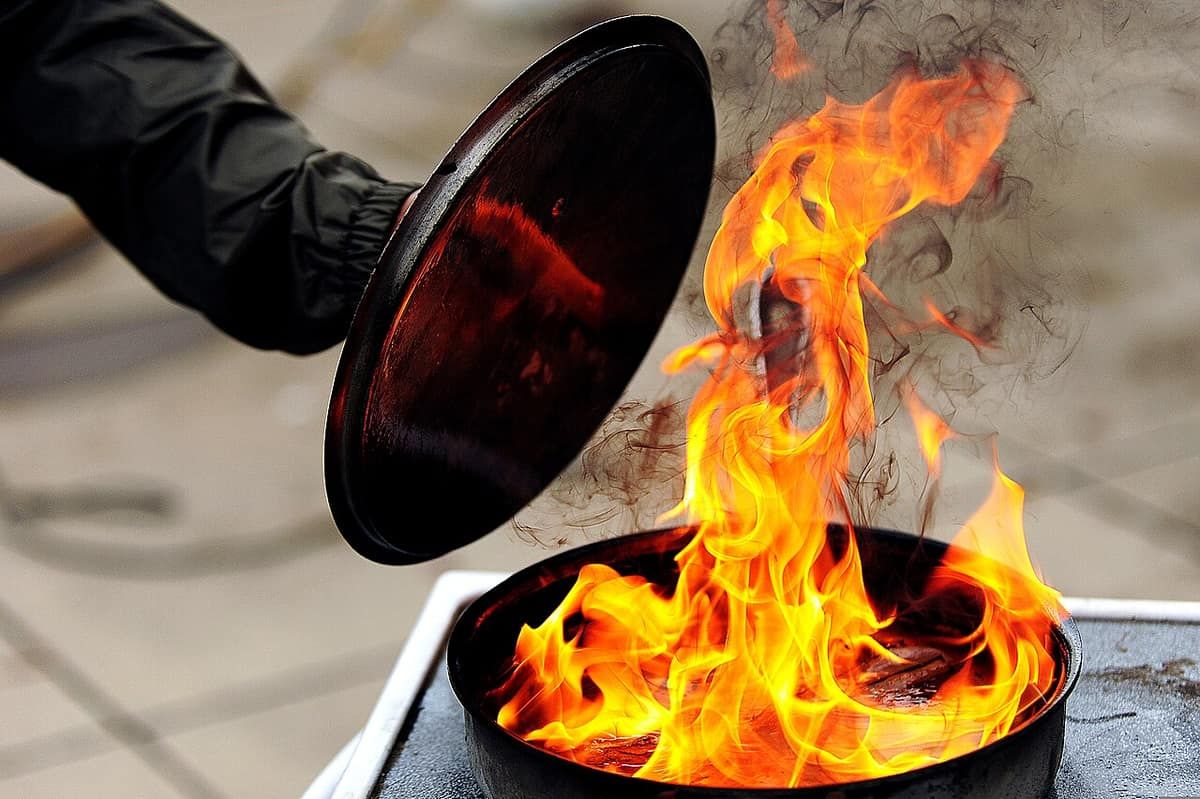
To put out a grease fire, turn off the burner if it is safe to do so, slide a lid or baking sheet over the pan and leave it covered until completely cool, per NFPA, the U.S. Fire Administration and local fire services. Never use water, and don’t move the pan. If the fire spreads beyond the pan, get out, close the door and call 911.
What to do if a pan of oil catches fire, step by step
A fire needs heat, oxygen and fuel, and it keeps burning until one is removed, per a Lincoln County, North Carolina fire handout.
- Turn off the burner to stop adding heat (Lincoln County), but only if it is safe to do so, per Essex County Fire and Rescue Service.
- Put on oven mitts if they’re at hand (Lincoln County).
- Slide a lid or baking sheet over the pan. NFPA’s Home Cooking Fires report says flames from a small oil or grease fire can be smothered by sliding a lid over the pan and turning off the burner. NFPA, Montgomery County and Lincoln County all use the word slide; Lincoln County says to slide the lid that fits the pan across the top of it.
- Use metal, not glass. The Lincoln County handout says to use a metal lid because glass will shatter. That is a county fire handout’s guidance; none of our other sources addresses glass lids.
- Don’t move the pan. Lincoln County warns that moving it can splash burning oil on you and the kitchen.
- Leave it covered until it is completely cool. NFPA says to keep the pan covered until then, and Montgomery County Fire and Rescue and Lincoln County repeat it. The lid works by cutting off oxygen, Lincoln County explains.
Why you should never use water on a grease fire
Water turns a pan fire into a bigger one. The Lincoln County handout says dousing burning grease with water or milk will make it explode into a fireball: the oil splashes and spreads the fire, and the vaporizing water can carry grease particles with it.
Essex County Fire and Rescue Service in England puts it more bluntly: water and hot oil don’t mix, and even a single drop can cause a flash fire. Its March 2026 warning followed a Chelmsford chip pan fire in which a man suffered burns to his face after trying to tackle the fire and becoming disorientated in thick smoke.
Does baking soda put out a grease fire?
Sometimes, on a small fire. The Lincoln County handout says baking soda will put out a grease fire only if it’s small, and that it takes a lot. It doesn’t give a quantity, and neither does any other source we read, so we won’t invent a cup measure. The evidence here is thin.
Salt is often recommended online alongside baking soda. None of the fire-service or government sources we opened mentions salt, so treat it as unverified.
Flour and other baking mixes are a firm no. Lincoln County says flour may look like baking soda but is combustible and won’t react the same way.
The lid still comes first: it is NFPA’s recommended method.
Should you put a lid on a grease fire?
Lincoln County says to use the lid that fits the pan, and it only helps if it is already within reach. USFA’s cooking safety page says to keep a pan lid or baking sheet nearby and use it to cover the pan if it catches fire, and Montgomery County says to keep a lid nearby whenever you cook.
A baking sheet or cookie sheet is the fallback when the lid isn’t close, per USFA and Lincoln County. Slide it across the same way.
None of the sources we opened covers fire blankets for pan fires, so follow your local fire service’s advice on them.
Myths and outdated advice about grease fires
The wet towel. The 2014 Lincoln County handout suggests soaking a towel, wringing it out and draping it over the pan. Essex County Fire and Rescue said in 2026 never to use a damp or wet tea towel, calling it outdated advice. Given that one fire service now warns against it and NFPA, USFA, Montgomery County and Lincoln County all recommend a lid, skip the towel.
Carrying the pan outside. Don’t. Lincoln County says moving the pot can splash burning oil on you, your home and anything nearby.
Should you use a fire extinguisher on a grease fire, or get out?
Montgomery County Fire and Rescue’s first advice for any cooking fire is “Just get out!”: close the door behind you and call 911 after you leave. USFA’s extinguisher guidance says to use an extinguisher only if all of these are true:
- Others have been alerted and the fire department has been called.
- You are physically able.
- The fire is small and contained, like a pan.
- You are safe from toxic smoke and have a clear escape route.
If you are unsure, alert others, leave and call 911. USFA adds that young children and older adults should not use extinguishers.
The reason to take this seriously: NFPA found that more than half of non-fatal home cooking fire injuries happened while people were trying to control the fire themselves.
USFA says Class B extinguishers cover flammable liquids including grease and oil, and multipurpose ABC models handle most home fires. Class K is for vegetable and animal oils and fats in cooking appliances, and USFA says it is often found in commercial kitchens. For which one to keep at home, see what fire extinguisher to get for a kitchen.
Lincoln County calls an extinguisher a last resort because it contaminates the kitchen. If you do use one, the handout warns that the discharge pressure can tip the pan and spread burning grease, so start from a distance and move closer. For technique, see how to use a fire extinguisher.
Oven and air fryer fires
For an oven fire, Montgomery County Fire and Rescue says to turn off the heat and keep the door closed.
If an air fryer is smoking rather than burning, see why an air fryer smokes and whether air fryers are safe.
After the grease fire is out
Leave the lid on until the pan is completely cool, per NFPA. If a smoke alarm didn’t sound, see where to put a smoke detector near a kitchen.
How common are grease fires?
Oil and grease drive the worst of U.S. cooking fires. NFPA’s figures are annual averages for 2017 to 2021. USFA’s cooking page reports different totals for 2021 alone, an estimated 170,000 home cooking fires and 135 deaths; the figures cover different periods and estimates, so don’t mix them.
| Metric (NFPA Home Cooking Fires, 2017-2021 annual avg.) | Value | What it means for a pan fire | Source |
|---|---|---|---|
| Home cooking fires per year | 158,400 (44% of home fires) | Cooking is the leading cause of reported home fires | NFPA, Sept 2023 |
| Civilian deaths per year | 470 (18% of home fire deaths) | Second leading cause of home fire deaths | NFPA, Sept 2023 |
| Civilian injuries per year | 4,150 (42% of home fire injuries) | Leading cause of home fire injuries | NFPA, Sept 2023 |
| Fires involving ranges or cooktops | 53% of fires, 88% of deaths, 74% of injuries | The stovetop is where the danger is concentrated | NFPA, Sept 2023 |
| Oil, fat or grease as first item ignited | 51% of fires that began with cooking materials | Half of food-started fires are oil or grease | NFPA, Sept 2023 |
| Oil and grease share of cooking-material losses | 53% of deaths, 75% of injuries, 78% of damage | Oil and grease cause most of the harm from food fires | NFPA, Sept 2023 |
| Non-fatal injuries while fighting the fire | More than half | Knowing when to leave matters as much as the lid | NFPA, Sept 2023 |
Stopping the next grease fire
Lincoln County’s handout says oil boils, then smokes, then ignites, and puts the smoke point at roughly 450°F for most vegetable oils and 375°F for animal fats such as lard; those are the handout’s approximations. If you see smoke, turn the heat down or off. NFPA notes that UL 858, effective June 2018, requires electric coil ranges made now to either not ignite cooking oil in a cast-iron pan or keep the pan’s average inside-bottom temperature at or below 725°F, and that it could be years before such ranges are common in homes.
For habits, see how to prevent kitchen fires. Devices can reduce risk but guarantee nothing: see do stovetop fire suppressors work, the StoveTop FireStop review, the Kidde FA110G review and kitchen safety devices.
More on kitchen fire safety
- Best kitchen safety devices
- What fire extinguisher for a kitchen
- Do stove shut-off devices work
- How we research
Frequently asked questions
Can you put water on a grease fire?
No. Never put water on a grease fire. Essex County Fire and Rescue Service warns that even a single drop of water on burning oil can cause a flash fire. A Lincoln County, North Carolina fire handout adds that water or milk makes the oil splash and spread, and the vaporizing water can carry grease particles that spread the fire.
Does baking soda put out a grease fire, and how much do you need?
Baking soda can put out a grease fire only if it's small, and it takes a lot, according to a Lincoln County, North Carolina fire handout. No source we read gives a quantity. NFPA's recommended method is to slide a lid over the pan and turn off the burner, so reach for a lid before baking soda.
Should I put a lid on a grease fire, and when can I take it off?
Yes. NFPA says flames from a small oil or grease fire can be smothered by sliding a lid over the pan and turning off the burner. Keep the pan covered until it is completely cool, per NFPA and Montgomery County Fire and Rescue. The lid works by cutting off oxygen, the Lincoln County, North Carolina handout explains, which is why it stays on until the pan cools.
Is a wet towel safe to put over a pan fire?
Fire services disagree, so the safer choice is not to use one. A 2014 Lincoln County, North Carolina handout suggests a wrung-out damp towel, but Essex County Fire and Rescue Service said in 2026 never to use a damp or wet tea towel because it is outdated advice. NFPA, USFA, Montgomery County and Lincoln County all recommend a lid or baking sheet instead.
When should I stop trying and get out?
Get out if the fire spreads beyond the pan or you are unsure. USFA says to use an extinguisher only if others are alerted, the fire department is called, the fire is small and contained, you are safe from smoke and have a clear escape route; otherwise leave and call 911. Montgomery County Fire and Rescue adds: close the door behind you.
Sources
- content.nfpa.org/-/media/Project/Storefront/Catalog/Files/Research/NFPA-Research/US-Fire-Problem/Fire-causes/oscooking.pdf
- usfa.fema.gov/prevention/home-fires/prevent-fires/cooking
- usfa.fema.gov/prevention/home-fires/prepare-for-fire/fire-extinguishers
- montgomerycountymd.gov/montgomery-county-fire-rescue-service/public-education/public-education-safety-resources/safety-tip-sheets/cooking-safety-tip-sheet
- lincolncountync.gov/DocumentCenter/View/7740/How-to-Put-Out-a-Grease-Fire
- essex-fire.gov.uk/incidents/firefighters-plea-after-man-injured-chip-pan-fire-2026-03-31-14-25