Single vs Double Boiler Espresso Machine: Do You Need Two?
Single boiler, heat exchanger, dual boiler or thermoblock? What each heater does to your milk-drink workflow, with manual specs and measured wait times.
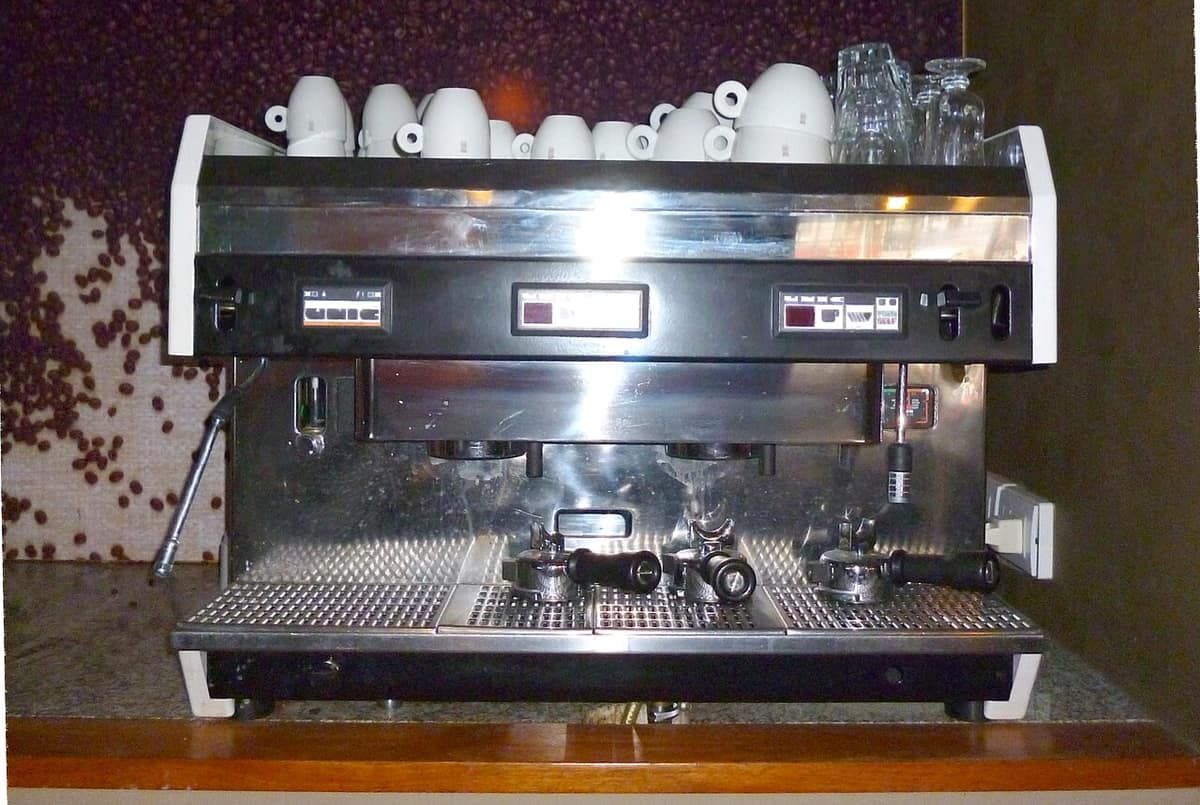
In the single vs double boiler espresso machine choice, the difference is waiting. A single boiler espresso machine heats brew water and steam with one heater, so you pull the shot, wait for steam temperature, steam, then wait again before the next shot. A double (dual) boiler keeps one boiler at brew temperature and one at steam, so you can do both at once, per Breville’s BES920 manual. Most machines in our espresso machine picks have no boiler at all: they use a thermoblock or thermocoil, which is also one heater doing both jobs.
That matters more than the boiler count suggests. If you make one milk drink at a time, one heater is fine. If you make three lattes back to back every morning, the waits add up.
The four heating systems in one table
This is the thermoblock vs boiler espresso question laid out by type, with one example machine each. Ready times are credited to whoever measured them; anything from a manual is labeled manufacturer spec. Where no source we read gives a number, the cell says so.
| Heating system | Example machine | Brew and steam at once? | Ready time (labeled: manufacturer spec or who measured) | Brew temperature control | Main trade-off | Source |
|---|---|---|---|---|---|---|
| Single boiler | Gaggia Classic E24 (lead-free brass boiler, manufacturer spec) | No, one at a time (Wikipedia, CoffeeBlog, for single boilers) | Brew-ready light 90.5 s after power-on; steam-ready light took 60 s (both measured by Whole Latte Love) | No PID (Whole Latte Love); a 3°F in-puck range during extraction (measured by Whole Latte Love) | Wait between brewing and steaming | Gaggia E24 page; Whole Latte Love; Wikipedia |
| Thermoblock | CASABREWS CM5418 | No (TechRadar) | About 40 s (TechRadar) | Not adjustable (TechRadar) | Needs to cool down between drinks (TechGearLab) | TechRadar; TechGearLab |
| Thermocoil with PID | Breville Barista Express BES870 | Not stated in the manual; steam light flashes while it heats to steam (manufacturer spec) | Not published | Electronic PID, adjustable (manufacturer spec) | Steam shuts off after 5 minutes of continuous steaming (manufacturer spec) | BES870 manual |
| ThermoJet with PID | Breville Bambino Plus BES500 | Not stated in Breville’s manual | Ideal extraction temperature in 3 s (manufacturer claim) | Electronic PID (manufacturer spec) | Heat-up claim not independently measured in sources read | BES500 manual |
| Heat exchanger | Lelit Mara, Rocket Appartamento (CoffeeBlog’s examples) | Yes (CoffeeBlog) | Not published in sources read | 4 to 6 s cooling flush before the first shot (Wikipedia) | Better steaming at the expense of brew-temperature stability (Wikipedia); start “from around the grand mark” on UK-based CoffeeBlog | CoffeeBlog; Wikipedia |
| Dual boiler | Breville Dual Boiler BES920 | Yes, dedicated espresso and steam boilers (manufacturer spec) | Not published | PID, default 200°F, adjustable 190 to 205°F; steam default 275°F (manufacturer spec) | Larger and more expensive (Wikipedia); about double HX prices (CoffeeBlog) | BES920 manual; Wikipedia; CoffeeBlog |
Single boiler: one tank, two temperatures
A single boiler stores water and heats it to brew temperature, then has to climb higher to make steam. Wikipedia calls this “single boiler, dual use” and says these machines can only do one operation at a time, with a warm-up period between the shot and frothing. CoffeeBlog names the Gaggia Classic and Rancilio Silvia as examples.
Gaggia says the Classic E24 has a lead-free brass boiler, draws 1350 W at 120 V and runs a 15 bar nominal pump (manufacturer spec). It also says the larger boiler stores more heat for better temperature stability and longer steam. Gaggia’s page gives no boiler capacity and doesn’t mention PID.
Whole Latte Love, a retailer that sells the machine, measured the E24. The brew-ready light came on 90.5 seconds after power-on, and it timed the steam-ready light at 60 seconds. It describes the E24 as a single boiler without a PID.
Whole Latte Love reported the brass boiler holds 3.68 oz against 2.5 oz for the older aluminum one, and it heated 5 oz of 42°F milk to 140°F in 24 seconds. Treat those as one retailer’s numbers, not an independent lab’s.
One caution if you shop used: some units of the 2023 Evo Pro shed flakes of their boiler coating, per CoffeeBlog, which says Gaggia blamed how the coating was applied and later moved the E24 to a brass boiler.
Thermoblock vs boiler espresso: why cheap machines heat fast
A thermoblock or thermocoil heats water as it flows through, instead of keeping a tank hot. CoffeeBlog calls them on-demand heating elements, an alternative to a brew boiler. The payoff is speed. TechRadar says the CASABREWS CM5418 uses a thermoblock “like most entry/mid level espresso machines” and was ready in about 40 seconds.
Breville uses its own names. The BES870 manual describes the Barista Express thermocoil as an integrated stainless steel water coil with electronic PID. When you turn the dial to steam, the light flashes while the machine heats to create steam. Before brewing, Breville says to run a short flow through the group head to stabilize temperature.
The Bambino Plus ThermoJet “achieves ideal extraction temperature in 3 seconds,” per Breville’s BES500 manual. That’s a manufacturer claim; none of the sources read for this page timed it.
The downside is back-to-back drinks. TechGearLab says the CM5418 needs time to cool down between drinks or it can burn the coffee. On temperature stability, the evidence is thin: no independent measurement of thermoblock brew temperature turned up in the sources read for this page. Wikipedia says boiler-plus-thermoblock machines trade steam speed for brew stability, but that’s about hybrids, not one-heater machines.
Sources also disagree on labels. CoffeeBlog lists the Barista Express as a single boiler; Breville’s manual says thermocoil. CoffeeBlog also calls the Bambino Plus a thermocoil machine, while Breville’s manual says ThermoJet. We go with the manuals; in practice the workflow is the same: one heater, one job at a time.
Single boiler vs heat exchanger
A heat exchanger (HX) machine has one boiler kept at steam temperature. A pipe runs through it and heats fresh brew water on the way to the group head, so you can steam and brew at once, per CoffeeBlog. Wikipedia adds that brew water is always fresh from the tank, and that HX machines need a 4 to 6 second cooling flush before the first shot.
Klatch Coffee describes HX differently, as boiled water mixed with cold water. CoffeeBlog and Wikipedia both describe the pipe-through-the-boiler design, so that’s the one used here.
CoffeeBlog’s examples are the Lelit Mara and Rocket Appartamento, and the UK-based site says HX machines start “from around the grand mark.” No HX machine is in our registry or under our hub’s $700 cap, so there’s nothing here to recommend.
Dual boiler: what the second boiler buys you
Breville’s BES920 manual lists dedicated espresso and steam boilers “for simultaneous milk texturing and espresso extraction” (manufacturer spec). It adds a 950 ml steam boiler, dual pumps, an actively heated group head and PID. Default shot temperature is 200°F, adjustable from 190 to 205°F, and default steam temperature is 275°F.
What you get is no waiting and two controllable temperatures. Wikipedia says dual boilers give stable brew temperature and fast steaming but are larger and more expensive. It also notes the brew boiler’s water is mostly stagnant, with little turnover.
CoffeeBlog says dual boilers tend to start at around double HX prices and take longer to warm up than HX machines. It also notes the Sage (Breville) Dual Boiler adds a heat exchanger that preheats the water feeding its boiler. The BES920 is here as a reference only; it’s above our hub’s price range.
Do I need a dual boiler?
Decide by how you drink, not by the spec sheet.
- Straight espresso, or one milk drink at a time: a single heater with PID covers it. The Bambino Plus and Barista Express both list PID in their manuals. On the thermoblock CM5418, TechRadar says switching between modes takes mere seconds and is mainly a problem for multiple milk drinks.
- Two or more milk drinks back to back every morning: the wait compounds. Each drink means switching to steam and back, and TechGearLab says the CM5418 needs cool-down time between drinks. Brewing and steaming at once means a heat exchanger or dual boiler, per CoffeeBlog, and neither sits in our hub’s price range.
- Light roasts and temperature experiments: look for adjustable PID before a second boiler. The Barista Express manual lists adjustable temperature control; TechRadar says the CM5418’s temperature isn’t reprogrammable.
The thin spot: no source we read measured total time per latte by heater type. Anyone quoting “a latte takes X minutes on a single boiler” should say who timed it.
What to check on a spec sheet
- One heater, one job at a time: “thermoblock”, “thermocoil”, “ThermoJet”, “single boiler”.
- Brew and steam together: “heat exchanger” or “HX”, “dual boiler” or “double boiler”.
- Hybrid: “boiler plus thermoblock”. Wikipedia says this layout gives steadier brew temperature at the cost of steaming speed. Coffee Chronicler describes the Miicoffee Apex V2 as a brew boiler plus a thermoblock for steaming, and says its heat-up time sits around 7 to 10 minutes.
- PID: electronic temperature control. Separate from boiler count.
- Steam-ready indicator and steam limits: the BES870 disables steam after 5 minutes of continuous steaming.
- Pressure: the bar number on the same sheet means something else; see espresso machine bar pressure explained.
Boilers also hold scale; see how to descale an espresso machine.
Where each machine in our hub fits
- CASABREWS CM5418: thermoblock, per TechRadar. Review.
- De’Longhi Stilosa: stainless steel boiler, per De’Longhi’s product page; Tom’s Guide’s spec list says the same. Review.
- Breville Bambino Plus: ThermoJet with PID, per its manual. Review. The Bambino BES450 also lists a ThermoJet system and PID on Breville’s product page; the two are compared in Bambino vs Bambino Plus.
- Breville Barista Express: thermocoil with PID, per its manual. Review.
- Gaggia Classic E24: lead-free brass single boiler, per Gaggia.
Ranking lives on our espresso machine picks, not here. Everything above comes from manuals and the sources listed; see how we research.
More on espresso machines
- Best espresso machines
- Espresso machine bar pressure explained
- Pressurized vs non-pressurized basket
- How to descale an espresso machine
- How we research
Frequently asked questions
Can you steam milk and pull a shot at the same time on a single boiler machine?
No. A single boiler does one job at a time, so you brew, then wait for the boiler to reach steam temperature, then steam. Wikipedia describes single boiler dual use machines as needing a warm-up period between the shot and frothing, and CoffeeBlog says you can't steam milk and pull a shot at the same time on one.
Is a thermoblock better than a boiler for espresso?
A thermoblock is faster to heat, not clearly better in the cup. TechRadar found the thermoblock CASABREWS CM5418 ready in about 40 seconds, while Whole Latte Love measured 90.5 seconds before the Gaggia Classic E24's boiler showed brew-ready. No independent measurement of thermoblock brew-temperature stability turned up in the sources read for this page.
What is the difference between a heat exchanger and a dual boiler?
A heat exchanger has one steam boiler with a pipe that heats brew water on the way through, while a dual boiler keeps two separate boilers. Both let you brew and steam at once, per CoffeeBlog. Wikipedia says heat exchangers need a 4 to 6 second cooling flush first; dual boilers give stable brew temperature but are larger and costlier.
Do I need a dual boiler if I only make one latte a day?
Probably not. The dual boiler's advantage is brewing and steaming at once, which matters most when drinks are made back to back. For one latte, the wait on a single heater is one switch to steam. On the CASABREWS CM5418, TechRadar says switching between modes takes mere seconds and calls it a problem mainly for multiple milk drinks.
Is the Breville Barista Express a single boiler or thermocoil?
Breville's own BES870 manual says the Barista Express uses a thermocoil heating system, an integrated stainless steel water coil, with electronic PID temperature control. CoffeeBlog lists it as a single boiler machine. CoffeeBlog says single boiler machines can't steam and pull a shot at the same time; the manual doesn't state that directly, but says the steam light flashes while the machine heats to create steam.
Sources
- breville.com/content/dam/breville/us/assets/miscellaneous/instruction-manual/espresso/BES920-instruction-manual.pdf
- breville.com/content/dam/breville/us/assets/miscellaneous/instruction-manual/espresso/BES870-instruction-manual.pdf
- williams-sonoma.com/netstorage/pdf/142739-Breville-Bambino-Plus-Manual.pdf
- gaggia.com/manual-machines/new-classic-e24
- wholelattelove.com/blogs/reviews/gaggia-classic-pro-e24-review
- techradar.com/home/coffee-machines/casabrews-cm5418-review
- techgearlab.com/topics/kitchen/best-espresso-machine
- coffeeblog.co.uk/single-heat-dual-boiler-espresso-machine
- coffeeblog.co.uk/boilergate-gaggia-classic-pro-evo-boiler-problems
- en.wikipedia.org/wiki/Espresso_machine
- klatchcoffee.com/blogs/knowledgebase/how-to-choose-a-single-or-double-boiler-espresso-machine
- coffeechronicler.com/gear/espresso-machines
- tomsguide.com/best-picks/best-espresso-machines
- delonghi.com/en-us/p/stilosa-stilosa-espresso-machine/EC260BK.html
- breville.com/en-us/product/bes450