Kidde Fire Extinguisher Recall: How to Check Yours
How to check if your Kidde fire extinguisher is recalled: handle and pull-pin style, the DDDYY date code, model lists, and how to get a free replacement.
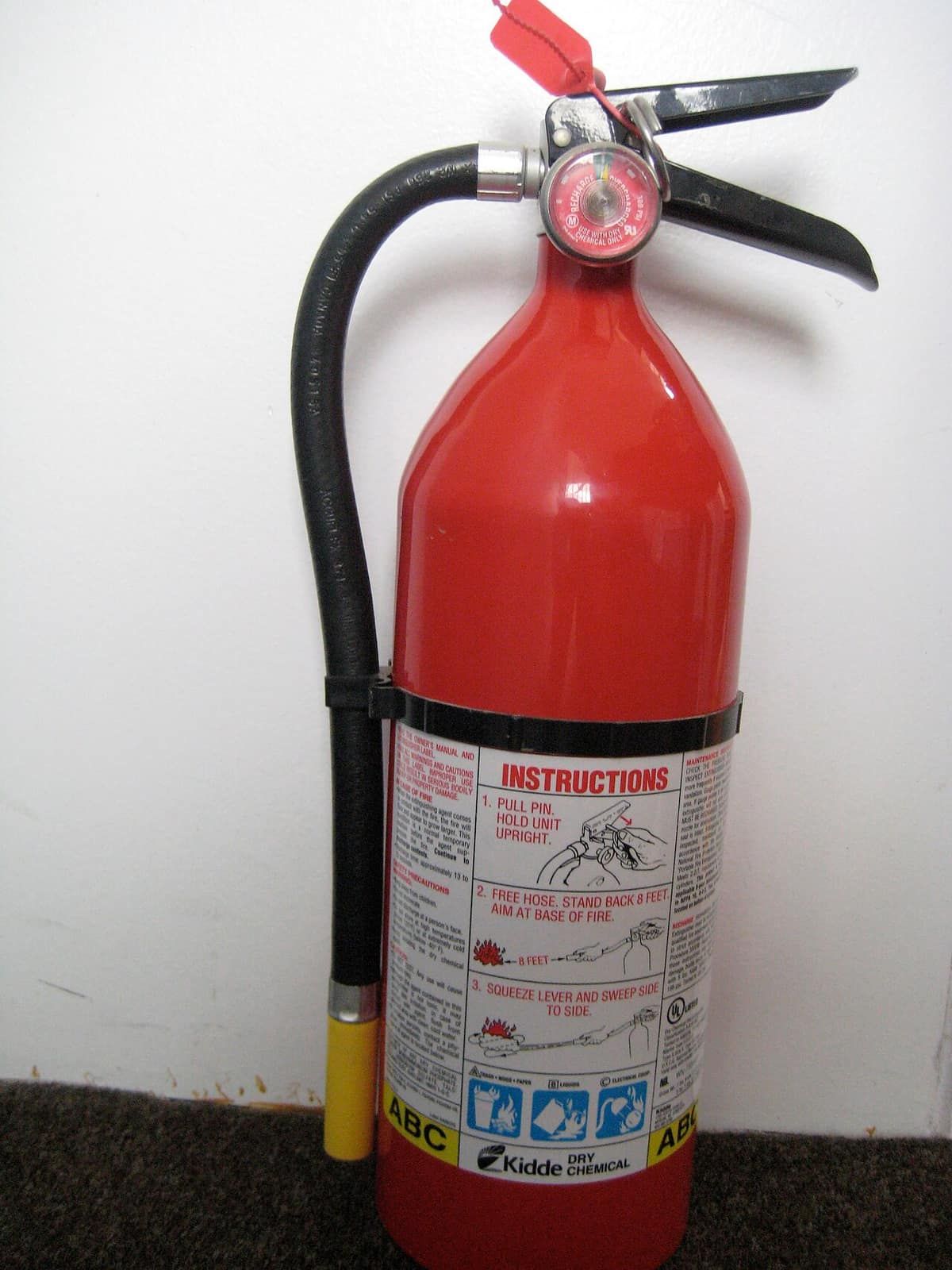
To check whether a Kidde fire extinguisher is recalled, look at the handle and pull pin first, then read digits 5 to 9 of the date code. CPSC recall 18-022 covers 134 plastic-handle models made from Jan 1, 1973 to Aug 15, 2017, and 8 push-button Pindicator models made from Aug 11, 1995 to Sep 22, 2017. Replacement is free.
This page is a research summary of CPSC notices, Kidde’s recall documents and fire-safety agencies, not a hands-on inspection of any unit. See how we research.
Step 1: Check the plastic handle and pull pin
The pin and handle are the fastest visual test. They matter most on units made before 2007, which have no date code to cross-check. Kidde’s recall ID guide says that if the extinguisher has a gauge, the first thing to look for is a vertically oriented pull pin, either fixed with two connections or hanging from a single connection. Per the guide, certain affected units also have a straight plastic handle.
Per the same guide, these styles are not affected:
- Any metal handle with a metal pull pin, in any style.
- A curved black plastic handle with a horizontal plastic pull pin.
Per CPSC, the recalled plastic-handle units were sold in red, white and silver and are ABC- or BC-rated. Kidde’s guide says the unaffected curved-handle units also come in red, white or silver and ABC or BC ratings, so color and rating will not settle it either way.
Step 2: Is it a push-button Pindicator model?
Some recalled Kidde units have no lever at all. CPSC describes the push-button Pindicator extinguishers as red and white, with no gauge and a red or black nozzle, sold mainly for kitchen and personal watercraft use. They were made from Aug 11, 1995 to Sep 22, 2017.
CPSC names eight models: KK2, M5PM, 100D, AUTO 5FX, 210D, AUTO 5FX-1, M5P and FF 210D-1. If your unit is a push-button type with one of these model numbers, it is in the recall.
Step 3: How to read the Kidde date code
Per CPSC, units made in 2007 or later carry a 10-digit date code printed on the side of the cylinder, near the bottom. Ignore the first four digits and the last one. Digits 5 to 9 are DDDYY: three digits for the day of the year, then two for the year.
A made-up example: a code reading 1234 12015 6 has 12015 in positions 5 to 9. That is day 120 of 2015, which is April 30, 2015.
CPSC lists the recalled plastic-handle models with date codes from 00212 through 22717, which is January 2, 2012 to August 15, 2017. Compare the year digits first and the day digits second; don’t compare the five digits as one number.
Units made before 2007 have no date code, per CPSC. The recall reaches back to 1973, so a missing code does not clear a plastic-handle unit. On an undated unit, the pin and handle style is what you have to go on; if the pin, handle and code seem to point different ways, confirm with Kidde.
Step 4: Find the model number on the label
CPSC says the model number is printed on the extinguisher’s label. Have it and the date code ready before you contact Kidde.
Models named in CPSC’s plastic-handle list include FA110G, FA10G, FA5-1, FC10, FX5 II and H110G, alongside the push-button KK2, M5P, M5PM and AUTO 5FX. The full list of 134 plastic-handle models is on the CPSC notice; we don’t copy it here, so you always check the current version.
Kidde fire extinguisher recalls at a glance
| Recall (CPSC no. / date) | Which units | Manufacture dates | Date code range (digits 5-9, DDDYY) | US units | Reported failures / injuries / deaths | Hazard (per CPSC) |
|---|---|---|---|---|---|---|
| 15-079 / Feb 12, 2015 | 31 disposable models with black Zytel plastic valves | Jul 23, 2013 to Oct 15, 2014 | 20413 to 36513 (2013); 00114 to 28814 (2014) | About 4.6 million | 11 failures to discharge / no injuries reported / none reported | Faulty valve can stop a full discharge when the lever is pressed repeatedly |
| 18-022 / Nov 2, 2017 | 134 plastic-handle models and 8 push-button Pindicator models | Jan 1, 1973 to Aug 15, 2017 (plastic handle); Aug 11, 1995 to Sep 22, 2017 (push-button) | 00212 to 22717 for listed plastic-handle models; none before 2007 | About 37.8 million | About 391 / about 16 / 1 | Can clog or need excessive force and fail to activate; nozzle can detach with force |
Sources: CPSC recall notices 15-079 and 18-022.
Does the 2017 recall cover the 2015 disposable units?
The earlier recall was narrower. CPSC recall 15-079 covered about 4.6 million US units and 175,000 in Canada: 31 disposable models with black Zytel plastic valves, made Jul 23, 2013 to Oct 15, 2014. Their codes run from XXXX 20413 X to 36513 X for 2013 and 00114 X to 28814 X for 2014, stamped on the cylinder near the bottom.
CPSC’s 2017 notice says it includes fire extinguisher models previously recalled in March 2009 and February 2015. So if you own a unit from either earlier recall that was never replaced, the 2017 recall covers that model too.
The 2017 action is about clogging, excessive activation force and nozzle detachment, not corrosion. CPSC puts it at about 37.8 million US units, plus 2.7 million in Canada and 6,730 in Mexico.
What to do if your Kidde extinguisher is recalled
CPSC’s wording is direct: contact Kidde immediately for a free replacement and instructions for returning the recalled unit, because it may not work properly in a fire emergency. Philadelphia’s Department of Licenses and Inspections also says the replacement is free.
Sources give two different phone numbers:
- CPSC’s 2017 notice lists 800-880-6788.
- Kidde’s current recall ID guide lists 855-271-0773 in the US and 1-855-233-2882 in Canada, plus a link to start the replacement registration online. Philadelphia’s November 2017 release also gave 855-271-0773.
Use the number on Kidde’s current recall page, since that is the one Kidde maintains.
Don’t count on a recalled unit while you wait. Keep your smoke alarms working (see smoke detector placement near the kitchen).
The U.S. Fire Administration says to use any extinguisher only on a small fire contained to one object or surface, such as a pan. The fire department should already be called and you need a clear way out. Otherwise, alert others, leave and call 911. For stovetop emergencies, read how to put out a grease fire.
What to do if your extinguisher is not recalled
Being outside the recall says nothing about the unit’s condition. Gauge checks and replacement age are covered in how long fire extinguishers last, and technique in how to use a fire extinguisher.
Consumer Reports advises filling out the warranty card and registering your contact information with the manufacturer so you are notified directly of a recall, checking that the pressure gauge dial is in the green zone, and visiting SaferProducts.gov to see whether a product is recalled.
Why the 2017 Kidde recall still matters in 2026
The recall was large and linked to real failures. CPSC reported about 391 failed or limited activations or nozzle detachments, about 16 injuries, about 91 property-damage reports and one death. That death followed a 2014 car crash fire in which emergency responders could not get the recalled extinguishers to work.
The recall has been re-publicized since. The Kansas State Fire Marshal re-posted it on Aug 12, 2019 as still ongoing. Per Consumer Reports, the Department of Justice, assisted by CPSC, filed a complaint in late December 2020. It alleged Kidde failed to inform CPSC in a timely manner and, before the 2015 recall, significantly underreported the scope of the defect. Kidde agreed to pay a $12 million fine to settle it without admitting it violated federal law.
When we checked Kidde’s product safety notices page in September 2026, the only extinguisher recalls listed were Feb 12, 2015 and Nov 2, 2017. Later notices cover alarms, not extinguishers. Recheck that page if you read this much later.
Is the Kidde FA110G recalled?
The FA110G appears in CPSC’s 2017 plastic-handle list, among models with date codes from Jan 2, 2012 to Aug 15, 2017. Whether a particular FA110G is covered depends on its handle and pin style and its date code, so run steps 1 and 3 on it. The sources we read don’t say which handle style current FA110G units use, so check yours rather than assuming. Our Kidde FA110G review covers the product itself.
More on kitchen fire safety
- Best kitchen safety devices
- Kidde FA110G review
- What fire extinguisher for a kitchen
- How to prevent kitchen fires
- How long fire extinguishers last
- Blender recall check
Frequently asked questions
How do I know if my Kidde fire extinguisher is recalled?
Check the handle and pull pin first. Per Kidde's recall ID guide, look for a vertically oriented pull pin on a unit with a gauge; some affected units also have a straight plastic handle. Push-button Pindicator units are affected. Metal handles with metal pins and curved black plastic handles with horizontal pins are not. Then compare the model number and date code with CPSC recall 18-022.
Where is the date code on a Kidde fire extinguisher and how do I read it?
The date code is a 10-digit number printed on the side of the cylinder near the bottom, per CPSC. It appears on units made in 2007 or later. Digits 5 to 9 give the day of the year and the two-digit year, so 12015 means the 120th day of 2015.
Is the Kidde plastic handle recall still active?
Kidde still lists the November 2, 2017 plastic-handle and push-button recall on its product safety notices page, which we checked in September 2026. The Kansas State Fire Marshal re-posted it in August 2019 as still ongoing. Kidde's page lists no newer fire extinguisher recall after 2017.
Is the Kidde FA110G recalled?
Some FA110G units are. CPSC's 2017 recall notice lists the FA110G among plastic-handle models with date codes from January 2, 2012 to August 15, 2017. Whether yours is covered depends on its handle and pull-pin style and its date code, so check both and confirm with Kidde.
Should I keep using a recalled extinguisher until the replacement arrives?
Do not rely on it. CPSC says to contact Kidde immediately for a free replacement because a recalled unit may not work properly in a fire emergency. USFA says to use an extinguisher only on a small fire contained to one object or surface, with the fire department called and a clear escape route; otherwise alert others, get out and call 911.
Sources
- cpsc.gov/Recalls/2018/Kidde-Recalls-Fire-Extinguishers-with-Plastic-Handles-Due-to-Failure-to-Discharge-and-Nozzle-Detachment-One-Death-Reported
- cpsc.gov/Recalls/2015/Kidde-Recalls-Disposable-Plastic-Fire-Extinguishers
- kidde.com/product-safety-notices-fire-extinguishers-recall-id-guide
- kidde.com/product-safety-notices
- consumerreports.org/product-safety/kidde-mishandled-problems-with-fire-extinguishers-for-years-a6601128859
- firemarshal.ks.gov/m/newsflash/Home/Detail/23
- phila.gov/press-releases/department-of-licenses-and-inspections/major-fire-extinguisher-recall-issued
- usfa.fema.gov/prevention/home-fires/prepare-for-fire/fire-extinguishers